Entrada de blog
Más allá del filtro: cómo decidir entre Web AR, apps y AR social para potenciar tu estrategia de marketing
The Rise of Augmented Reality in Experiential Marketing
Augmented reality has become a widely used tool within experiential marketing. It allows digital elements to be superimposed onto an image of the real-world environment through devices such as smartphones or tablets, creating experiences in which users can observe, explore, or manipulate interactive content.
This technology can be used to communicate brand stories, visualize products, or develop participatory experiences. Examples include virtually trying on products and visualizing furniture inside a space before making a purchase.
Within experiential marketing, augmented reality can encourage more active audience participation. Its results depend on the creative concept, ease of access, technical execution, context of use, and the campaign’s distribution strategy.
However, the augmented-reality ecosystem is diverse, and not every implementation works in the same way. Different formats—including Web AR, social-media effects, and dedicated applications—each present their own characteristics, advantages, and limitations.
Choosing the appropriate format is essential to the success of a brand activation because it directly affects accessibility, the level of immersion, cost, and potential for social sharing.
Understanding these differences is the first step toward designing an AR strategy aligned with the marketing objectives, budget, context of use, and campaign evaluation metrics.
What Is Web AR, and Why Is It the Most Accessible Entry Point?
Web-based augmented reality, or Web AR, allows certain augmented-reality experiences to run through a compatible browser without requiring the installation of a dedicated application.
Users can access an experience through a link or QR code, although it will generally require a secure connection, permission to use the camera, and compatibility between the device, browser, and technology being used.
The lack of an installation process can reduce some of the steps required to access the experience compared with a downloadable application.
However, this does not guarantee a broader reach or a specific participation rate, as the result also depends on permissions, compatibility, connectivity, device performance, and the clarity of the experience.
Web AR can be distributed through websites, links, digital campaigns, or QR codes.
Its reach depends on device and browser compatibility, the permissions requested, the framework being used, the internet connection, and the complexity of the experience.
Sharing a URL can also simplify distribution when compared with an application that must first be installed.
Metrics are not collected automatically. Analytics tools must be implemented, and the events that will be recorded must be defined.
Access to a user’s precise location requires explicit permission and must be managed in accordance with the applicable privacy policies.
Web AR may present limitations in performance, compatibility, and access to certain device functions when compared with a native application.
These differences depend on the browser, operating system, framework, hardware, and type of tracking required.
The session can also be interrupted when the user closes the browser tab, although a web-based experience may retain certain data through storage mechanisms or backend services.
Because of these characteristics, Web AR can be appropriate for quick-access activations, provided that its requirements are validated in advance on the target devices.
At Cinetica Studio, we have used Web AR for a variety of activations, taking advantage of its ease of access to generate large-scale impact.
For example, in projects where the objective is for users to quickly interact with a virtual product or participate in a simple game, the immediacy of Web AR has proven to be an important factor in the success of the experience.
It allows a brand to reach its audience directly, transforming almost any physical space into a digital interaction point through a simple scan.
Augmented-Reality Effects: Social Sharing and Reach on Social Media
Social augmented-reality effects are currently distributed through platforms such as TikTok and Snapchat.
Instagram was one of the channels that popularized this format, but Meta discontinued the Meta Spark creation platform and removed third-party effects on January 14, 2025.
Instagram should therefore no longer be presented as an available channel for publishing new custom brand effects through Meta Spark.
These effects operate within each platform’s application, and their reach depends on distribution, commercial rules, approval processes, and the usage habits of the platform’s audience.
Social augmented-reality effects run within the application of the corresponding platform.
The user must have that application installed and access the effect through a post, a profile, a link, a search, or, in some cases, a QR code.
This integration can facilitate the creation of user-generated content, although its availability depends on the functions and rules of each platform.
When a brand publishes a social augmented-reality effect, it can invite users to create content through visual transformations, 3D objects, or interactive mechanics.
The possibility of sharing this content within the platform can contribute to its distribution, although it does not guarantee virality or organic reach.
Social augmented-reality effects are subject to limits on file size, loading time, scene complexity, polygon count, texture resolution, and resource consumption established by each platform.
For this reason, 3D models, animations, and interactive logic must be optimized and tested on compatible devices.
From a brand perspective, AR effects are well suited to awareness campaigns, product launches with a strong visual component, and playful forms of interaction.
They allow brand elements, logos, or characters to be integrated into users’ everyday lives, helping create an emotional and memorable connection.
Integration with the social platforms’ metrics can also provide useful data regarding reach, impressions, and engagement, although with less granularity than a proprietary application.
At Cinetica Studio, we evaluate social augmented-reality effects when the campaign objective includes the creation and distribution of content within a specific platform.
Their suitability depends on the audience profile, the available technical capabilities, the social network’s commercial policies, and the media plan.
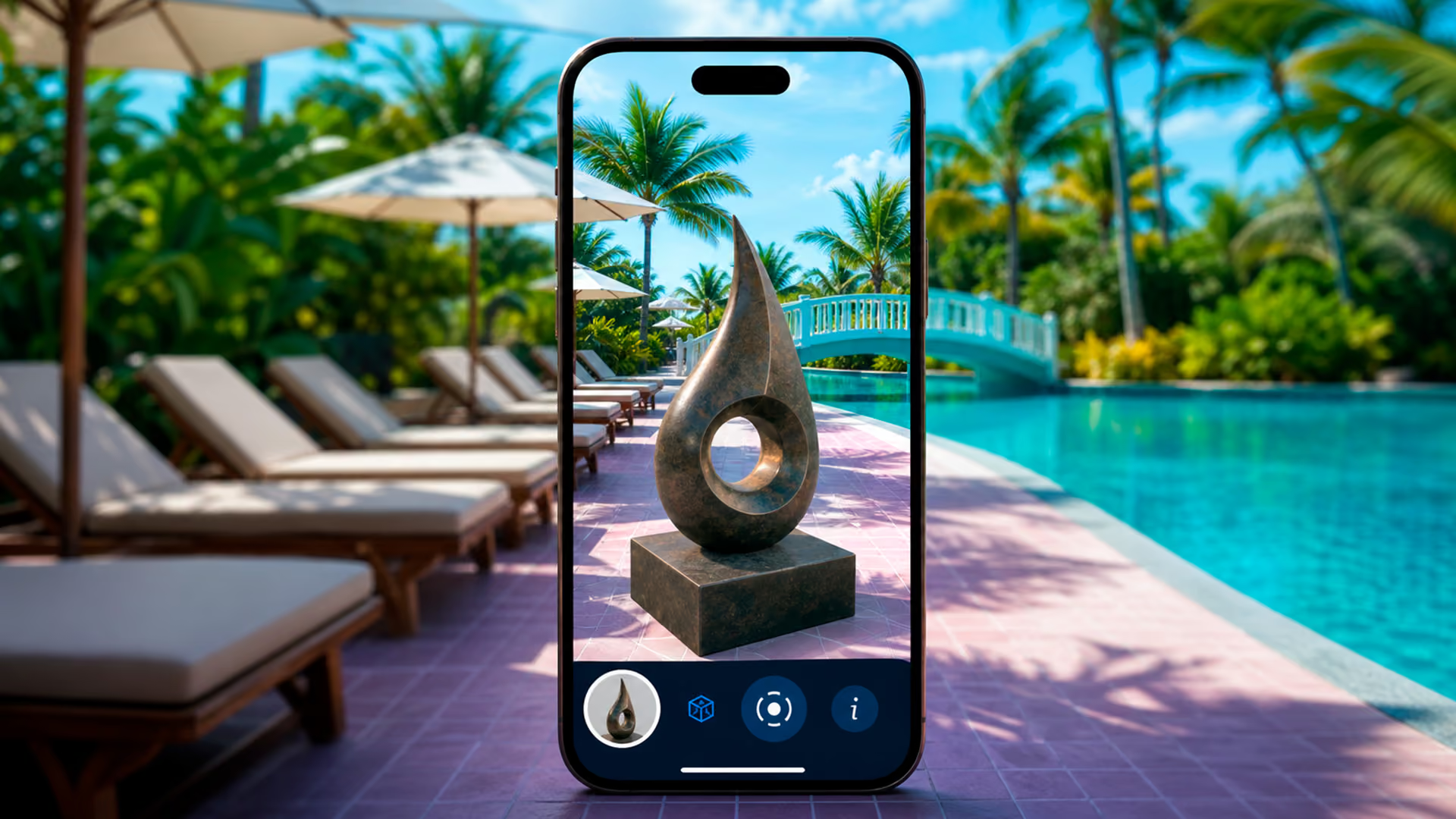
Augmented-Reality Applications: Deeper Immersion and Advanced Functionality
A native augmented-reality application is installed directly on the device and can offer greater control over performance, hardware access, integrations, and the life cycle of the experience.
This does not mean that it is automatically more immersive or more appropriate. Its suitability depends on the objectives, device, budget, and required functions.
Native applications can access functions offered by frameworks such as ARKit or ARCore, including spatial tracking, surface detection, depth, occlusion, and the recognition of certain objects or images.
The availability and accuracy of these functions depend on the device model, its sensors, the operating-system version, the framework, and the implementation.
Persistence between sessions is not automatic either.
It requires anchors or spatial information to be saved and retrieved through compatible functions and, in some cases, additional services.
Developing a native application may require more integration, testing, maintenance, and distribution work than other formats, particularly when it must operate across multiple systems and devices.
When it is released to the general public, the publication and review processes of the relevant app stores must also be taken into account.
Requiring a download can add steps to the user journey, but it should not be assumed that the resulting audience will necessarily be more engaged.
Reach will depend on the application’s utility, distribution, communication, and expected frequency of use.
Native applications can be integrated with product catalogs, user accounts, purchasing systems, backend services, and device-specific functions.
Data collection depends on the analytics implementation, permissions, consent, and the applicable privacy policies.
Examples of visualization tools include features within Sephora’s application and IKEA Kreativ, which is available through both the IKEA application and website.
These cases demonstrate different approaches to integrating visual analysis or spatial design, but they do not, by themselves, support claims that they reduce returns or produce a particular commercial result.
Key Comparison: Web AR vs. Social Effects vs. Apps for Your Activation
The choice between Web AR, social-media effects, and native augmented-reality applications depends directly on the marketing objectives, budget, and desired level of immersion for a brand activation.
Each format offers distinct advantages and limitations that must be evaluated carefully.
Ease of access is a critical factor.
Web AR performs strongly in this area because it does not require a download. Scanning a QR code or clicking a link opens the experience directly in the user’s browser, reducing friction.
Social effects, meanwhile, are accessible within social-media platforms, making them easier to discover and use for people who are already active users of those platforms.
Native applications, in contrast, require a download from an app store. This may represent a barrier for some users, although the application can provide a more robust experience once installed.
Cost does not depend exclusively on the format.
The creative concept, content production, 3D modeling, interactive logic, integrations, target devices, licenses, infrastructure, testing, moderation, maintenance, and distribution must all be considered.
A complex social effect may cost more than a simple Web AR experience, while a limited native application may require less investment than a social campaign involving extensive production and paid media.
Potential reach varies considerably.
AR effects have an inherent potential for social sharing, driven by the dynamics of social networks and the ease with which content can be shared.
Web AR offers broad potential reach because it is not tied to a single platform and can be integrated into different digital channels, including websites, emails, and advertising.
Although native applications can reach large audiences when a brand successfully motivates users to download them, they are generally more appropriate for specific audiences or repeated-use experiences.
Graphic complexity and immersion are areas in which native applications can perform particularly well.
They can manage detailed 3D models, complex animations, and deeper interactions with the physical environment.
Web AR has advanced significantly and can support high-quality graphics and interactive experiences, although it continues to face certain limitations when compared with native applications.
Social effects have also improved, but they are generally more restricted in terms of visual complexity and interactivity because lightweight content is prioritized to enable fast loading.
Persistence and metrics depend on the architecture and functions permitted by each platform.
An installed application can preserve sessions, settings, or user accounts, while a Web AR experience can use browser storage or backend services.
Social effects provide the metrics made available by the respective platform.
Across all formats, the collection of information should be limited to the data that is necessary and must be managed with the appropriate permissions, notices, and consent.
Finally, the marketing objectives best suited to each format are relatively clear.
Social effects are appropriate for campaigns focused on awareness, social sharing, and engagement within social platforms.
Web AR is well suited to product-marketing campaigns, point-of-sale activations, and interactive information experiences that aim to reduce access friction.
Native applications are an appropriate choice for long-term, immersive brand experiences, loyalty programs, or utility-based tools requiring advanced functionality and deeper user interaction.
Success Stories: When Cinetica Studio Chooses Each Format
At Cinetica Studio, we select the architecture of each experience according to its objectives, context of use, audience, hardware, distribution strategy, and required level of interaction.
Some projects require dedicated software or integration with hardware without necessarily using augmented reality.
It is therefore important to distinguish between an AR experience and a custom-developed interactive application.
When a campaign seeks to distribute augmented-reality content within a social network, platforms such as TikTok or Snapchat may be evaluated.
The decision must consider the presence of the target audience, technical capabilities, publication policies, approval processes, and the commercial conditions of each platform.
Web AR can be considered when users need to access an experience through a browser without installing a dedicated application.
It can be used for product activations, 3D visualization, or virtual try-on experiences, provided that the required functions are compatible with the target devices and browsers.
Before using Web AR within a large-scale campaign, it is necessary to test permissions, performance, compatibility, loading behavior, connectivity, and operation across the selected operating systems.
Decisive Factors for Choosing the Appropriate AR Technology
Selecting the most appropriate augmented-reality technology for a brand activation is not a trivial decision.
It requires a strategic analysis of factors that extend beyond a simple technological preference.
Brands and agencies must carefully consider their objectives, resources, and audience context to maximize impact and return on investment.
The budget should be evaluated based on the complete scope of the project, including the concept, asset production, development, integrations, licenses, testing, infrastructure, publication, paid media, and maintenance.
No single format is always the least expensive option.
Campaign objectives can help define the channel, but they do not determine the solution on their own.
Social effects may support distribution within a platform, Web AR can reduce installation steps, and a native application can offer greater integration with the device.
The decision should only be made after validating the audience, required functions, compatibility, budget, and metrics.
The target audience also influences the technology selection.
It is advisable to evaluate which platforms they use, which devices they own, which operating systems are most common, which permissions they may be willing to grant, and whether downloading an application is viable within the campaign context.
Web AR, social effects, and native applications present different barriers.
The decision should therefore be based on audience data and user testing, rather than on assumptions that a particular group is more or less comfortable with technology.
Complexity must be evaluated function by function.
Object recognition, body tracking, occlusion, offline operation, and backend integrations may be available in different formats, but with varying degrees of compatibility, performance, and control.
A virtual try-on experience may also require advanced tracking, segmentation, and calibration, and should therefore not automatically be considered a simple experience.
Implementation time depends on the scope, assets, integrations, testing, approval processes, and the experience of the team.
A complex social effect may require more production work than a limited application, while Web AR can also demand extensive compatibility testing.

The Future of Augmented Reality in Marketing: Trends and Opportunities
Augmented reality continues to evolve through new devices, frameworks, and creation tools.
Within marketing, its future adoption will depend on factors such as utility, compatibility, privacy, cost, and user acceptance.
Integration with generative artificial intelligence may enable dynamic visual or narrative content.
However, an experience should not claim to recognize a user’s emotional state unless the signals being analyzed, the model being used, its limitations, and the required consent have been clearly defined.
It is also possible to personalize results using explicit user choices or information that the user has authorized.
The development of smart glasses and other devices may open new possibilities for contextual experiences that do not require users to hold a phone.
Their commercial adoption will depend on available hardware, comfort, battery life, privacy, price, and platform support.
Personalization may also increase, provided that data is collected and used transparently, with consent and a clearly defined purpose.
It should not be assumed that a personalized experience will automatically be more effective or less intrusive.
Creation tools may reduce certain technical barriers, but costs will continue to depend on content, integrations, testing, operations, and maintenance.
Augmented reality should therefore be presented as one option within experiential marketing rather than as an indispensable tool.
Conclusion
Augmented reality offers different possibilities for brands seeking to incorporate interactive experiences into their marketing strategies.
Web AR, social effects, and native applications each present different advantages, limitations, and requirements.
At Cinetica Studio, we analyze the objectives, audience, context, budget, and technical needs of each project to select an appropriate solution.
Results should be evaluated through metrics defined from the beginning of the campaign, without guaranteeing virality, brand recall, or return on investment in advance.
Frequently Asked Questions
What is the main difference between Web AR and a social-media effect?
Web AR allows users to access augmented-reality experiences directly through their web browser without downloading an application.
The experience can be accessed through a link or QR code.
Social-media effects, in contrast, are integrated into platforms such as TikTok or Snapchat and operate within the corresponding application. They are particularly suited to social sharing and user-generated content.
When should I choose an AR application instead of Web AR or a social effect?
A native application may be appropriate when the project requires deeper integration with the device, offline operation, greater control over performance, or functions that are not consistently available through a browser.
Its suitability should be evaluated in relation to cost, distribution, and the target devices.
Is augmented reality an expensive investment for brands?
The cost of an augmented-reality activation depends on the scope, assets, development, integrations, licenses, testing, infrastructure, distribution, and maintenance.
There is no universal cost hierarchy between social effects, Web AR, and native applications.
Return on investment must be measured using indicators defined for each campaign.
How can Cinetica Studio help my brand with augmented reality?
At Cinetica Studio, we design and develop custom interactive experiences.
We analyze the marketing objectives, budget, audience, context, and technical requirements to recommend an appropriate architecture, which may include Web AR, social effects, or dedicated applications.
Which metrics can I expect from an augmented-reality campaign?
Metrics may include accesses, sessions, interactions, time spent, experience-completion rates, shares, downloads, repeat usage, or conversions.
Their availability depends on the platform, analytics implementation, and permissions.
The impact on brand perception requires a specific methodology, such as surveys or brand studies, and cannot be inferred exclusively from interaction data.
Explore our portfolio of immersive experiences and discover how augmented reality can transform your next campaign.
Contact us for a personalized consultation regarding your augmented-reality project.
Related Articles
AR, VR, and Mixed Reality for Brands: Differences and Use Cases
AR Effects for Campaigns: How to Create Experiences People Share
What Is Experiential Marketing, and Why Do Brands Invest in Immersive Experiences?
Destacado en
Nuestro trabajo ha sido reconocido por publicaciones líderes del sector que cubren creatividad, tecnología e innovación.
Descubre entrevistas, reportajes y artículos que destacan nuestros proyectos y nuestra perspectiva.


También te puede interesar

¿Listo para crear algo extraordinario?
Desde el concepto hasta la ejecución, diseñamos experiencias que conectan a las personas, la tecnología y la narrativa de formas inolvidables.