Blog Post
Anatomy of risk: decisions that can compromise an immersive experience
The promise of the immersive experience: where does the road go wrong?
Creative technology allows the development of formats such as interactive installations, videomapping, augmented reality and virtual production. Each format has different technical, operational and budgetary requirements, and its suitability depends on the objective and context of the project.
The incorporation of a technology does not guarantee attention, differentiation, memorability or virality. These results require specific criteria and measurement methods.
A technically viable proposal may face problems during development or operation when the scope, dependencies, budget, and event conditions are not defined with sufficient precision. Risks include scope changes, incompatibilities between systems, insufficient testing times, mounting conditions other than those planned, and lack of backup mechanisms.
A failure can affect the schedule, budget, attention span, or availability of the experience. Its commercial or reputational impact will depend on the severity of the incident, its duration, public exposure and the objectives of the activation. Understanding where and why these paths bend is essential for any company that aspires to truly innovate and deliver experiences that not only surprise, but also work perfectly.
At Cinética Studio we develop projects that combine software, audiovisual content, hardware and on-site operation. This type of production requires identifying risks before assembly and defining how critical functions will be validated.
This article brings together risks that should be reviewed during the planning, development and implementation of an immersive experience.
Mistake #1: Unfocused vision or lack of a clear brief
One of the most costly pitfalls in developing immersive experiences and brand activations arises long before a line of code is written or a single pixel is rendered: the absence of a clear vision and detailed brief. When the objectives of the campaign are not clearly defined, the target audience is understood superficially or the initial brief is ambiguous, the project is born with an uncertain direction. This not only generates frustration, but results in a significant waste of resources, time and budget.
A poor brief is like trying to build a building without plans. The creative and technical team, no matter how talented, lacks the foundation necessary to make informed decisions. What do you seek to achieve with this experience? Is it increasing engagement, generating leads, strengthening brand perception or driving sales? Without concrete answers, each project iteration becomes a guessing exercise, leading to endless revisions and a cycle of trial and error that consumes valuable resources. The absence of objectives and measurement criteria defined from the beginning makes it difficult to evaluate the result of the project and relate the metrics obtained with the activation objectives.
Understanding the target audience is another fundamental pillar that, if neglected, can completely derail the experience. Designing an experience for an audience familiar with video games is not the same as designing an experience for a group that will use the proposed type of interface for the first time. Age, the context of the event or the professional position alone do not allow us to assume a person's level of technological familiarity. A brief that does not delve into these nuances condemns the experience to not connecting with its audience, resulting in an ineffective investment.
In the interactive floor developed for Coca-Cola, the system used TouchDesigner, MediaPipe, webcams and computer vision to modify graphics based on the position and movement of people.
This case explains why a technical proposal must clearly relate each technology to a function: capture, detection, processing and visual response. Without that clear vision, the project could have deviated into unnecessary complexities or functionalities that did not contribute to the main objective of the brand.
To avoid this mistake, it is essential that brands invest time in the conceptualization phase, working hand in hand with the creative studio. A detailed brief is not just a document, but a strategic map that aligns all stakeholders, defines project boundaries, and sets expectations for success. It includes not only the marketing objectives, but also the technical limitations, budget, schedule and, crucially, an in-depth description of the end user. This process helps establish a shared baseline for evaluating decisions, changes, and deliverables during the project.
Mistake #2: Underestimating technological complexity and integration
Underestimate technological complexity and integration
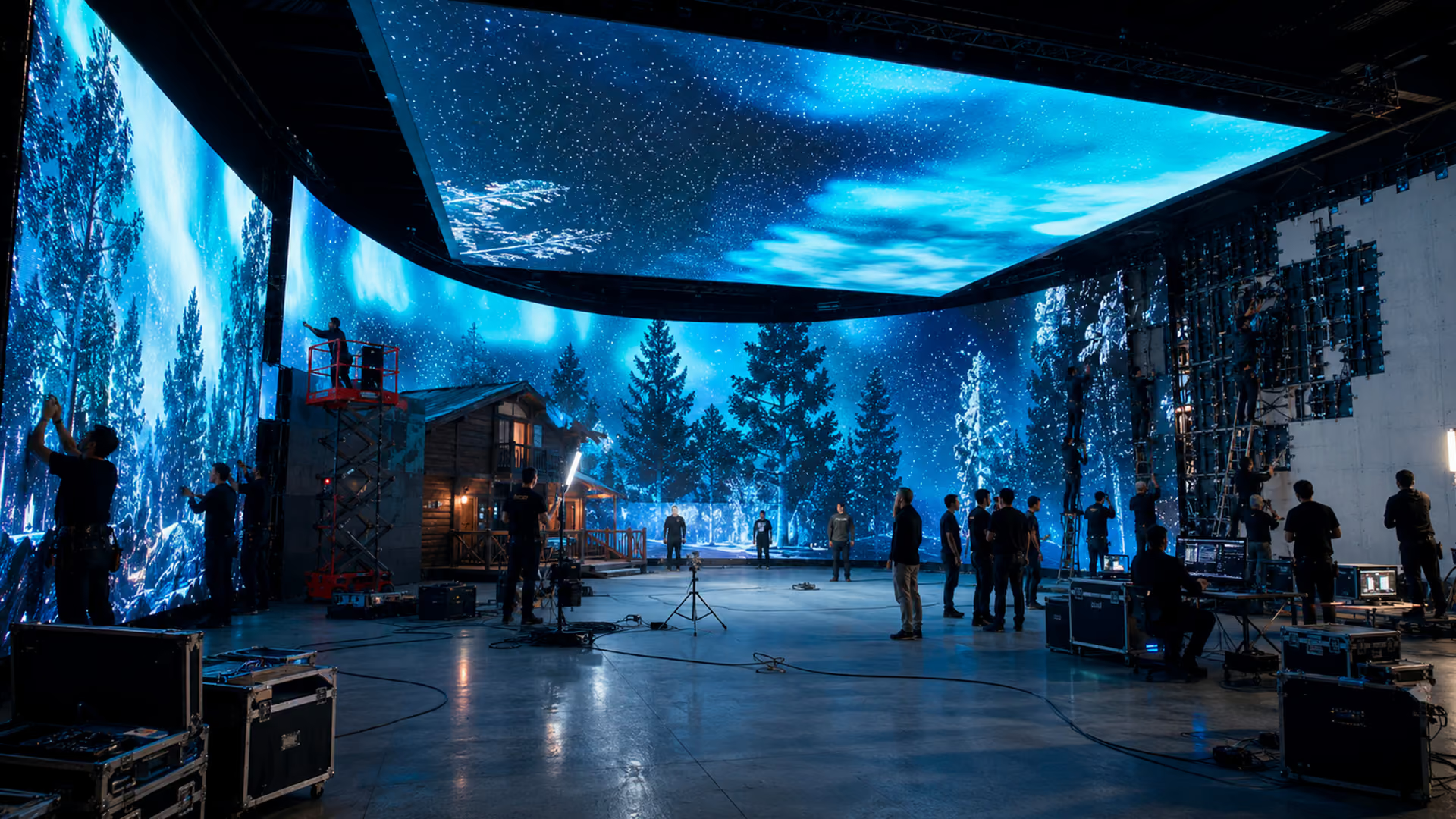
Some components can be integrated using existing solutions, while others require specific development and configuration. Compatibility, interfaces between systems, performance, allowed latency, and operating conditions should be reviewed before committing to an architecture. For example, a videomapping project may require surveying or geometry, producing surface-adapted content, selecting projectors and optics, calibration, and a playback system. The methodology depends on the scale and complexity of the installation. Any failure in these points can compromise the illusion and the experience.
Complexity increases when an experience depends on multiple devices and applications that must maintain a coordinated state. An example is the NESTLE NAN Pediatriex experience, whose architecture integrated an application developed in Unity, TouchDesigner as a control system, a main PC, a local network, MQTT and 130 tablets used by the participants.
In a system of this type, communication between clients and servers, the start and end of rounds, state synchronization and behavior in the event of disconnections or incomplete messages must be defined.
In the karaoke experience for Amazon Music, Unity was part of the experience control and the system integrated video and audio capture, clip generation, storage in Firebase and QR codes for each participant to access their content. Each stage had to be coordinated within the response time defined for the dynamics: capture, processing, storage and availability of the file. These steps must be validated from hardware selection to on-site operation.
Pre-production must identify risks, design tests, and define recovery mechanisms. On-site operation continues to require validation, monitoring and failure response capabilities.
Mistake #3: Unrealistic budgets and poor change management
A common risk in immersive experience projects is budgeting without considering all dependencies or incorporating changes without evaluating their impact. An unrealistic initial budget, whether due to excessive optimism, lack of experience estimating complex projects, or internal pressures to reduce costs, sets the stage for future conflicts and cost overruns. When financial expectations do not align with technical and creative reality, the project is headed toward frustration.
When a project includes features that have not yet been validated, the estimate must distinguish between known components and work that requires research, prototyping, or proof of concept. External dependencies, licenses, hardware, operation, transportation, and contingencies must also be identified. Brands and studios should collaborate in a detailed discovery phase, breaking down technical requirements, workflows and potential challenges, before setting a final figure.
The scope creep trap
Even with a well-founded initial budget, the lack of a clear process for managing scope changes can derail any project. Scope creep, or the gradual, uncontrolled expansion of project requirements, is a silent enemy. Small additions or modifications, which individually seem insignificant, add up quickly, consuming additional time, resources and budget. This is particularly true in projects where the creative vision is constantly evolving or where stakeholders add new functionality without a proper impact assessment.
The key to mitigating this risk is to establish a change management protocol from the beginning. This involves documenting each modification request, evaluating its impact on schedule and budget, and obtaining formal approval from all parties involved before proceeding. Transparent communication is essential: the studio must educate the client about the implications of each change, not only in terms of cost, but also time and technical complexity. In projects with multiple systems, any modification can affect more than one component. Therefore, a change request must identify which deliverables, integrations, tests, times, and costs it modifies before being approved.
A realistic budget and change management process helps evaluate the viability of a creative technology project. Ignoring them can increase the risk of cost overruns, delays, or deliverables that do not correspond to the agreed scope.
Mistake #4: Ignoring user experience and field testing
A critical mistake that can derail even the most technologically ambitious project is the neglect of user experience (UX) and the omission of extensive testing in real environments. An immersive experience must define how the interaction will begin, what actions the user can take, what response they will receive, and how they can recover from errors. When technology or visual concept is prioritized over how a person will actually interact with the facility, the result can be confusing, frustrating, and ultimately ineffective.
This oversight manifests itself in various ways: unclear interfaces, interaction mechanics that do not respond as expected, or an overly steep learning curve that alienates the audience. Testing under controlled conditions does not necessarily reproduce all the variables of an event. Lighting, noise, network, space, number of users and the final position of sensors or screens can modify operation.
Therefore, it is advisable to combine prototypes, integration tests and validations in conditions close to those of operation. These steps allow you to identify frictions and adjust interaction flows. In Cinética Studio, iterative testing can be integrated from the early stages of development. In the interactive floor for Coca-Cola, MediaPipe provided data for detecting and tracking people, while TouchDesigner used the information to modify the visual content. In this type of system, lighting, occlusions, detection area and the number of users must be tested.
In karaoke for Amazon Music, the flow included capture, clip generation, storage, and QR code access. Each stage had to be validated separately and later as part of the complete route. Ignoring operational and interaction details can compromise the functioning of an experience.
Mistake #5: Failures in team communication and coordination
Even with a clear vision, a realistic budget, and the right technology, an immersive experience project can be derailed by one seemingly basic factor: communication. Failures in communication and coordination between the various parties involved – the client, the creative studio, external suppliers, assembly and logistics teams – are a recurring source of misunderstandings, duplication of effort, costly rework and, ultimately, delays that impact the release date and budget.
The multidisciplinary nature of immersive experiences, which often combine 3D design, software development, hardware engineering, audiovisual production and event logistics, demands seamless orchestration. When each team operates in its own silo, critical information can be lost, expectations can diverge, and dependencies between tasks may not be properly managed. This manifests itself in scenarios like the client assuming a feature is included without clearly specifying it, or the creative studio delivering a component that doesn't integrate seamlessly with the assembly vendor's hardware.
Poor project leadership or the absence of a clear, single point of contact exacerbates this problem. Without one figure to centralize information, make quick decisions, and ensure that everyone involved is aligned on goals and schedule, the project becomes vulnerable to fragmentation. The lack of open and transparent communication channels, as well as the absence of regular follow-up meetings with clear agendas and documented minutes, are a breeding ground for misinformation.
In developing the interactive karaoke experience for Amazon Music, coordination had to encompass video and audio capture, clip generation, Firebase storage, and QR codes to deliver content. The complexity of these interactions requires defining those responsible, interfaces between teams and validation processes.
The interactive floor for Coca-Cola used TouchDesigner, MediaPipe, webcams and computer vision to detect and track people, and generate reactive graphics. The integration of hardware and software required on-site calibration, as well as coordination with the installation team and the client to align technical requirements and operating conditions.
To reduce coordination problems, responsible parties, communication channels, dependencies, approval criteria and a process for recording relevant decisions and changes must be defined. The frequency of meetings and the level of documentation should be adapted to the scale and complexity of the project.
Cinética Studio cases: architectures that require technical planning
The interactive floor for Coca-Cola integrated TouchDesigner, MediaPipe, webcams and computer vision to use people's position and movement as input data for visual content.
The NESTLE NAN Pediatriex experience used an architecture with Unity, TouchDesigner, a main PC, MQTT, a local network and 130 tablets. This type of system requires defining how instructions are distributed, how responses are received, and how device states are kept synchronized.
Both cases show that the complexity of an experience does not depend only on the number of technologies used, but on the dependencies between them. Critical functions, necessary testing, and expected failure behavior must be defined before operation.

Conclusion: plan and manage risks
Immersive experiences carry technical, operational and coordination risks. Some can be reduced through clear scope definition, validation of integrations, budgets that consider dependencies, and an incident-ready operation.
Turning an idea into an experience requires aligning objectives, architecture, budget, operation and user experience. These factors do not guarantee a commercial outcome, but provide a basis for evaluating decisions and changes during the project.
In an immersive experience, prevention consists of identifying what can fail, what functions are critical, and what measures are in place to detect, recover, or replace a component during operation.
Cinética Studio projects show different architectures: from computer vision systems and reactive graphics to experiences with multiple synchronized devices. Each requires different tests and acceptance criteria.
Technical expertise can reduce certain risks, but it does not eliminate unforeseen events or guarantee business results. The best defense against a failure is to define the scope, test critical integrations, and establish operation and recovery mechanisms before the event.
Featured in
Our work has been recognized by leading industry publications covering creativity, technology, and innovation.
Discover interviews, features, and articles that highlight our projects and perspective.


You may also like

Ready to create something extraordinary?
From concept to execution, we design experiences that connect people, technology, and storytelling in unforgettable ways.