Blog Post
CGI Product Visualization vs. Traditional Photography: The Strategic Choice for Retail and E-commerce Catalogs
The Evolution of Product Visualization: From Photo Studio to 3D Pixel
The landscape of product visualization for retail and e-commerce has undergone a radical transformation over the last decade. What was once limited to studio photography, with its logistical complexities and associated costs, has given way to a much more dynamic and technologically advanced visual ecosystem. In the digital age, an image is not just a complement; it is the main showcase, the silent salesperson, and often the decisive factor in a purchase.
This evolution is driven by an insatiable demand for high-quality, scalable, and, above all, consistent visual content. Today's consumers expect to see products from multiple angles, in different configurations, with variations in color and material, and in real-world usage contexts. For brands with extensive catalogs, this expectation quickly becomes a monumental logistical and financial challenge if addressed exclusively with traditional methods.
In this context, Computer Graphics (CGI) has emerged as a powerful and, in many cases, superior alternative to conventional photography. Product CGI, which involves creating photorealistic images from 3D models, allows brands to generate product visuals without the need for physical prototypes, expensive photo shoots, or inventory management for each shot. This ability to decouple visual creation from the physical product is a paradigm shift that redefines efficiency and creativity in product marketing.
The adoption of CGI is not merely a trend but a strategic response to the pressures of the digital market. The need to launch products quickly, to personalize offerings at scale, and to maintain an impeccable brand visual identity across all channels has accelerated the integration of 3D tools into marketing and sales workflows. This shift not only optimizes processes but also opens up a range of creative possibilities that traditional photography simply cannot match, from visualizing products not yet manufactured to creating immersive and personalized customer experiences.
Traditional Product Photography: Advantages, Limitations, and Hidden Costs
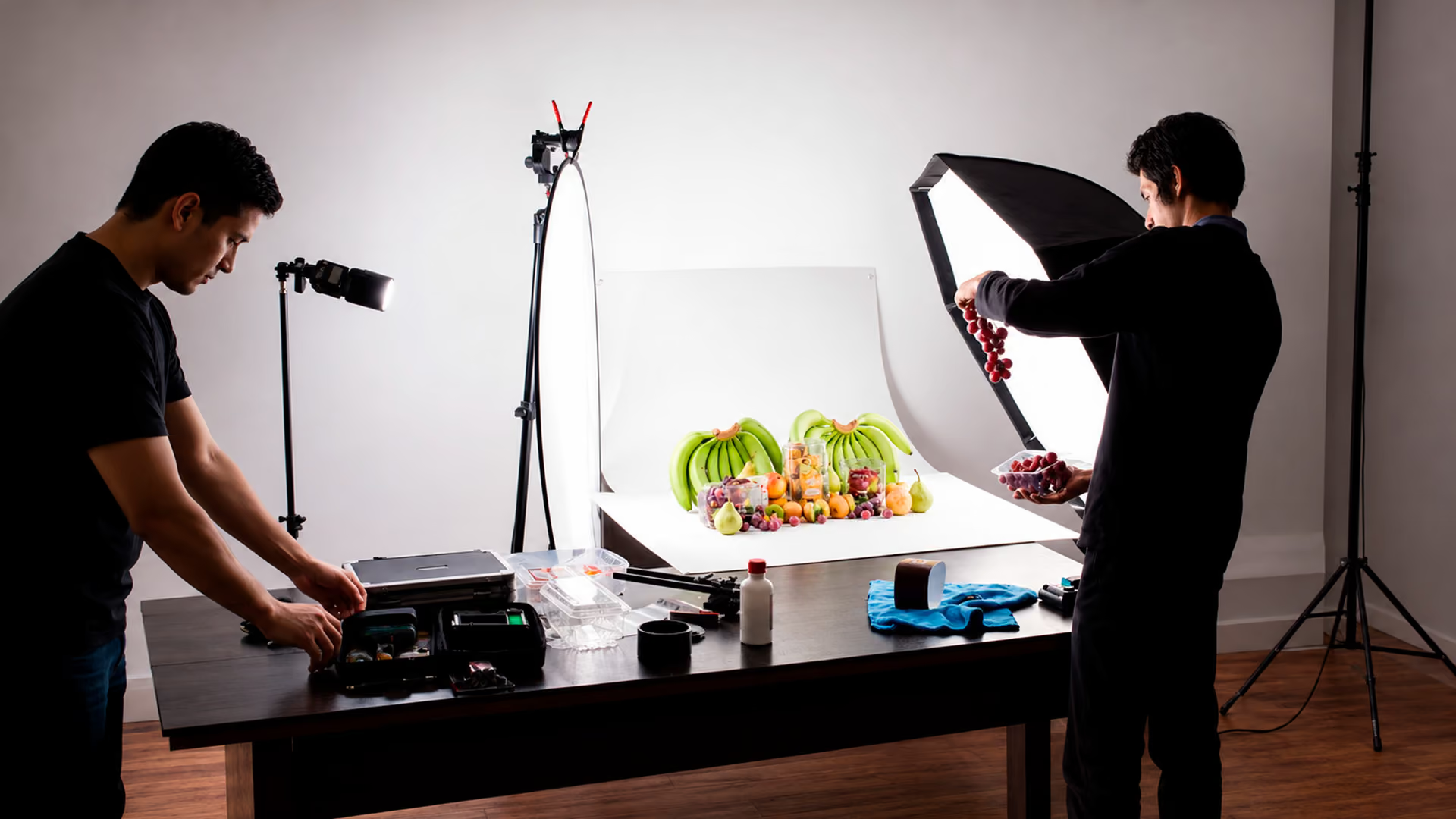
For decades, traditional product photography has been the gold standard for showcasing items in catalogs and on sales platforms. Its primary advantage lies in perceived authenticity: an image captured directly from a physical object conveys a sense of reality and tangibility that, for certain products or audiences, can be irreplaceable. Natural light, real textures, and subtle imperfections can add character that resonates with consumers, building trust and familiarity.
However, this authenticity comes with a series of significant limitations, especially when dealing with extensive catalogs or the need to maintain rigorous visual consistency. The process of photographing each product, in every color, material, or configuration variant, is inherently laborious and costly. It requires managing physical inventory, transporting products to the studio, hiring photographers, stylists, and lighting crews, and individually post-producing each image.
The hidden costs of traditional photography manifest on several fronts. The logistics of moving and storing products for photo shoots can be complex and expensive. Limitations in sets and environments are evident: recreating a specific environment for each product or variant is unfeasible. Furthermore, achieving perfect standardization in lighting, angle, and style across hundreds or thousands of products is a constant challenge. Small variations can break the visual cohesion of a catalog, affecting brand perception and user experience.
Revisions and re-edits represent another critical point. If a product undergoes a minimal modification in its design, color, or material, or if an error is detected in the final image, it is often necessary to repeat the entire photo shoot for that item. This means incurring logistics, production, and post-production costs again, which slows down launch cycles and increases operational expenses. For brands with seasonal collections or frequent launches, this rigidity becomes a bottleneck that directly impacts efficiency and agility in the market.
Product CGI: What It Is, How It Works, and Why It's a Game Changer
Product CGI (Computer-Generated Imagery) represents a qualitative leap in how brands visualize and present their items. Essentially, product CGI is the creation of photorealistic images and animations of objects, products, or entire scenarios using 3D graphics software. Unlike traditional photography, which captures existing reality, CGI constructs that reality from scratch in a digital environment, offering an unprecedented level of control and flexibility.
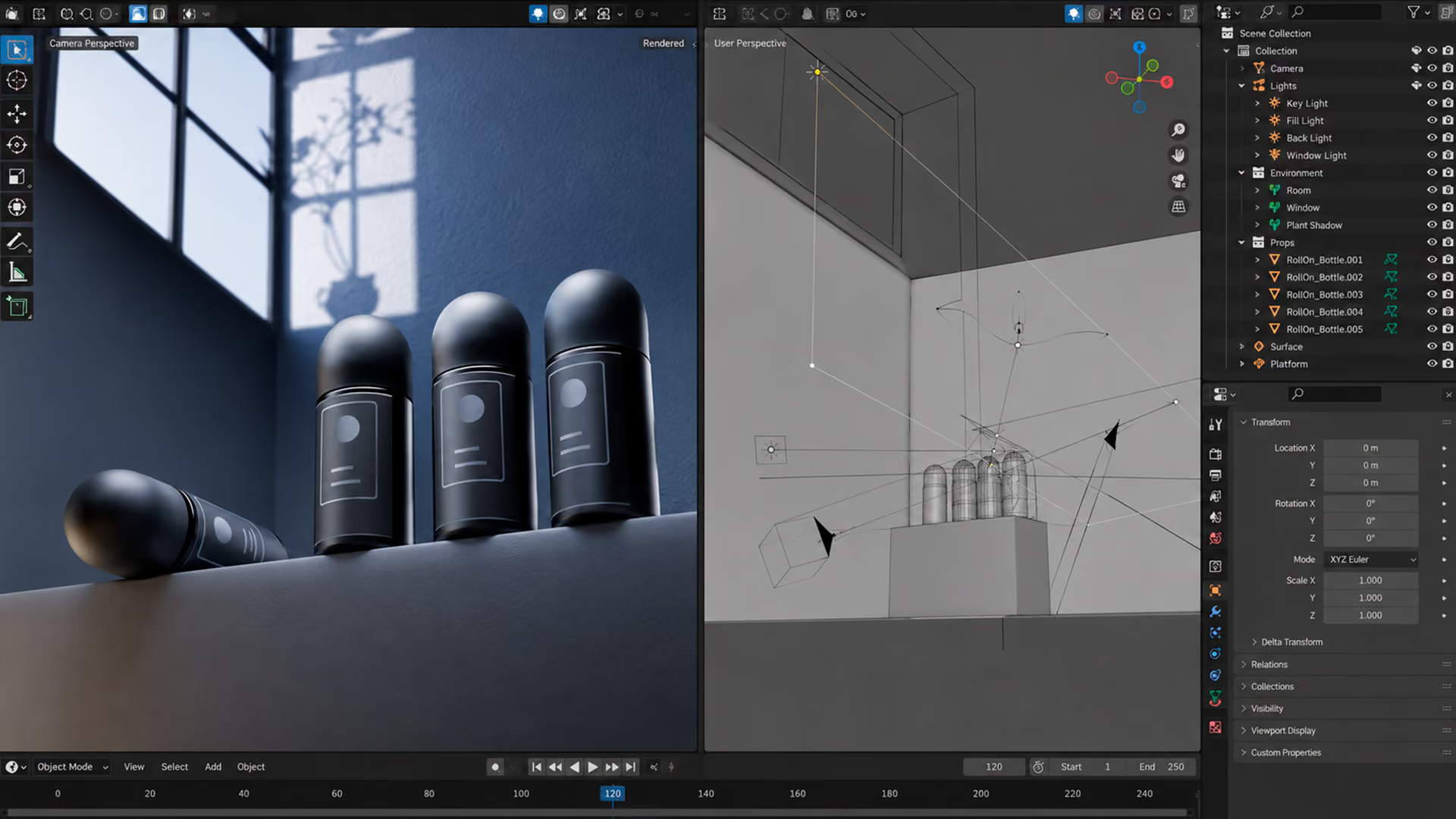
The process of creating product CGI is methodical and divided into several key stages. It all begins with 3D modeling, where a three-dimensional representation of the product is built. This can be done from CAD plans, sketches, or even 3D scans of a physical prototype. Every detail, from the most subtle curves to the most complex textures, is digitally replicated with millimeter precision. Once modeled, the next step is texturing and shading, where virtual materials are applied to simulate how light interacts with the object's surface. This includes properties such as color, reflectivity, roughness, transparency, and refraction, making metal look like metal, plastic look like plastic, and fabric have the desired drape and feel.
Subsequently, the lighting of the scene is defined. In CGI, lighting is as crucial as in real photography, but with the advantage of absolute control. Different types of light (natural, artificial, studio) can be simulated, and their intensity, color, and direction adjusted to highlight product features and create the desired atmosphere. Finally, the process culminates with rendering, which is the phase where the software "calculates" how light interacts with the 3D models and their materials, generating a two-dimensional image from the three-dimensional scene. This calculation can be resource-intensive, but the result is images of astonishing photorealistic quality, indistinguishable from a photograph.
The reason product CGI has become a game changer lies in its ability to generate perfect visuals without the need for a physical product. This eliminates the logistical barriers and costs associated with prototype production, transportation, hiring photographers and stylists, and studio rental. It allows brands to visualize products still in the design phase, create unlimited color or material variations with a click, and control every aspect of composition, angle, and lighting with a precision that traditional photography can hardly match. This autonomy and efficiency position it as an indispensable tool for modern retail and e-commerce.
Strategic Advantages of 3D CGI for Mass Retail and E-commerce Catalogs
The adoption of 3D CGI in creating mass catalogs for retail and e-commerce is not merely an aesthetic trend; it's a strategic decision that redefines operational efficiency and customer experience. For brands with vast product inventories, the advantages of CGI are magnified, offering solutions to logistical and creative challenges that traditional photography cannot match.
One of CGI's primary strengths is its unparalleled scalability. Once a 3D model of a product has been created, it can be rendered in countless configurations, angles, and environments without the need for additional photo shoots. This is crucial for catalogs with thousands of SKUs, where traditional image production becomes a logistical and financial bottleneck. The ability to quickly generate new images from a base digital asset significantly accelerates the time-to-market for new products and variations.
Visual consistency is another fundamental pillar that CGI guarantees. In traditional photography, factors such as lighting, background, angle, and equipment can subtly vary between sessions, resulting in a visually inconsistent catalog. CGI eliminates this variability by allowing absolute control over every rendering element. This ensures that every product, regardless of when or by whom it was created, maintains the same quality, style, and presentation, strengthening brand identity and catalog professionalism.
Flexibility to create color, material, and finish variations is a transformative advantage. Instead of photographing every possible combination of a product (e.g., a sofa in 20 different fabrics), CGI allows these variations to be applied digitally to a single 3D model. This not only saves costs and time but also opens the door to real-time visualization of customized or configurable products, a functionality increasingly in demand in modern e-commerce. This rapid iteration capability is invaluable for testing different aesthetics or responding to market demands without incurring physical prototyping costs.
From an economic perspective, 3D CGI represents long-term cost savings. While the initial investment in 3D modeling can be significant, the marginal costs of producing additional images, animations, or even interactive experiences from those models are drastically lower than those of repeated photography. Expenses associated with product logistics (shipping, storage, handling), studio rental, hiring photographers and stylists, and intensive post-production for each shot are eliminated.
In addition to static images, CGI opens up a range of possibilities for generating animations and interactive experiences. A 3D model can be used to create 360-degree videos, animations demonstrating a product's functionality, or even Augmented Reality (AR) experiences that allow customers to visualize the product in their own environment before purchasing. These tools enrich the shopping experience, increase engagement, and can reduce return rates by providing a more comprehensive understanding of the product.
Finally, CGI offers crucial independence from physical product logistics. It is not necessary to have the product manufactured or even a physical prototype to start creating its visuals. This is particularly advantageous for product launches, where marketing campaigns can begin long before inventory is available, or for large and difficult-to-transport products. This logistical autonomy allows brands to operate with greater agility and efficiency in a global and accelerated market.
When to Choose 3D CGI: Ideal Scenarios for Product Rendering
The decision to opt for 3D CGI over traditional photography isn't universal, but it becomes strategically superior in several key scenarios, especially for brands with extensive catalogs or complex products. Identifying these inflection points is crucial for optimizing resources and maximizing visual impact.
One of the most obvious cases is when products are still in the design or prototype phase. Before a physical version even exists, CGI allows for the generation of photorealistic visualizations for market testing, investor presentations, or even to kickstart pre-sale campaigns. This accelerates the launch cycle and reduces costs associated with producing physical prototypes solely for photography.
For catalogs with thousands of SKUs (Stock Keeping Units), 3D CGI becomes an indispensable tool. Visual consistency, scalability, and efficiency in managing variations (colors, materials, configurations) are unattainable with traditional photography at that scale. Each new product or variant can be rendered with the same lighting parameters and style, ensuring impeccable brand cohesion across the entire catalog.
The need for multiple angles, configurations, and interactive views is another determining factor. With CGI, a single 3D model can generate infinite perspectives, 360-degree views, exploded diagrams, or animations, without the need to re-set up a photographic studio. This is particularly valuable for customizable products or those that require showcasing their internal functionality.
Certain products are inherently difficult to photograph. Highly reflective items (jewelry, polished metals), transparent ones (glass, liquids), extremely large ones (furniture, vehicles), or very small ones (electronic components) present significant technical and logistical challenges for photography. 3D CGI allows for control over every aspect of light, material, and environment, achieving perfect representations that would be costly or impossible to obtain in a physical studio.
Finally, the growing demand for content for immersive experiences like AR (Augmented Reality) and VR (Virtual Reality) positions 3D CGI as the only viable solution. 3D models created for rendering can be optimized and exported for use in AR applications that allow customers to visualize products in their own environment, or in VR experiences that offer detailed virtual tours. This ability to reuse the 3D asset across multiple platforms and formats is a key competitive advantage that traditional photography cannot offer.
Integrating CGI into Brand Workflows: A Practical Approach
The transition from traditional photography to product CGI might seem complex, but with a clear strategy and the right collaboration, brands can seamlessly integrate this technology into their content production processes. Success lies in understanding that CGI is not just a tool, but a shift in the paradigm of visual creation.
The first step is collaborating with specialized creative technology studios. These partners bring not only technical expertise in 3D modeling, texturing, lighting, and rendering but also a strategic vision on how to optimize digital assets for different platforms and campaigns. A studio like Cinética Studio, for example, works hand-in-hand with brands to define project scope, desired visual styles, and necessary output formats.
A strong brief is fundamental. This document must go beyond product description; it should include visual references, detailed technical specifications, the product's use context, target audience, and marketing objectives. The clearer the initial vision, the more efficient the CGI production process will be. This allows 3D artists to create models that are not only photorealistic but also communicate the brand's essence and value.
3D asset management is another crucial pillar. As brands accumulate a catalog of 3D rendered products, the organization and accessibility of these models become vital. Establishing a 3D asset library allows for reusing elements, modifying textures or colors for new product variants, and adapting models for different campaigns without starting from scratch. This not only saves time and costs in the long run but also ensures visual consistency across the entire brand ecosystem.
The creative process with CGI is inherently iterative. Unlike photography, where corrections are typically limited to post-production, CGI allows for significant adjustments at every stage: from model shape, lighting, and materials, to scene composition. This flexibility is an advantage but requires constant communication and a well-structured feedback loop between the brand and the studio. Early and frequent reviews ensure that the final result aligns perfectly with the brand's expectations and objectives, optimizing time and resources invested.
Success Stories: Brands That Transformed Their Catalogs with 3D CGI
The adoption of 3D CGI is not new in product visualization, but its impact has been magnified in the retail and e-commerce sectors, where scale and efficiency are crucial. Numerous global brands have leveraged this technology to revolutionize how they present their products, optimizing costs, time, and visual quality.
A recurring example is seen in the furniture industry. Leading companies in home furnishings and decor have almost entirely abandoned traditional set photography. Instead, they use CGI to render sofas, tables, and accessories in an infinite number of configurations, colors, and textures. This allows them to showcase each product in multiple virtual environments, from an urban loft to a country house, without the need to build and dismantle costly physical sets. The ability to generate thousands of high-quality images with minimal variations, at a fraction of the cost and time of photography, has been a key differentiator in keeping their catalogs updated and appealing.
Similarly, the automotive sector has pioneered the use of CGI for its online configurators and marketing materials. Before a new model even rolls off the production line, brands can already present photorealistic renders with every imaginable color option, wheel design, and interior finish. This not only generates anticipation but also allows customers to virtually customize their vehicle, enhancing the purchasing experience and reducing the need to have all models and variants physically available at every dealership. The flexibility of CGI enables the creation of dynamic scenarios, from urban landscapes to scenic roads, which would be logistically complex and extremely expensive to photograph in real life.
In the realm of fashion and accessories, while model photography remains prevalent, CGI has found a significant niche in visualizing products such as jewelry, watches, and footwear. For these items, where intricate details and reflections are essential, CGI allows absolute control over lighting and materials, resulting in images of perfection unattainable with traditional photography. Brands can display their products from any angle, with subtle animations or even in augmented reality environments, offering an immersive experience that goes beyond a simple static image. This capability for rapid iteration and visual consistency is invaluable for catalogs that are constantly updated with new collections and variants.
The Future of Product Visualization: Beyond the Static Image
The journey of product visualization is far from over; in fact, we are only just witnessing the dawn of an era where the static image will merely be a starting point. The future is shaping up to be an increasingly deep integration of CGI with emerging technologies, transforming not only how products are seen, but how consumers interact with them.
One of the most promising trends is the convergence of CGI with generative artificial intelligence. This synergy will enable the automated creation of visual content at an unprecedented scale and speed. Imagine systems capable of generating thousands of variations of a product in different environments, with varying lighting and textures, based on a set of parameters and an initial 3D model. This will not only optimize production processes but also enable the personalization of images on a massive scale, adapting visualization to the individual preferences of each consumer in real-time.
Personalization will not stop at the static image. CGI will be the engine behind immersive and dynamic shopping experiences. From virtual try-on features that use augmented reality (AR) to superimpose products onto the user's environment, to fully virtual showrooms in the metaverse where consumers can interact with high-fidelity 3D models, rotate them, customize them, and see them in simulated contexts. These experiences, built upon quality 3D assets, will redefine the concept of "touch and feel" in e-commerce.
Furthermore, CGI's ability to generate versatile 3D assets positions it as a fundamental pillar for building metaverses and other extended reality platforms. Brands will be able to populate these new digital spaces with accurate representations of their products, creating coherent and engaging brand ecosystems. This will not only open new avenues for marketing and sales but also foster a deeper, more meaningful connection between the consumer and the brand.
In this scenario of constant evolution, a studio's ability to not only produce high-quality CGI but also to integrate these emerging technologies and anticipate market needs becomes crucial. Cinética Studio positions itself as a leader in this transformation, combining CGI mastery with the active exploration of generative AI and immersive experiences, to offer brands solutions that not only visualize the future but actively build it.
Featured in
Our work has been recognized by leading industry publications covering creativity, technology, and innovation.
Discover interviews, features, and articles that highlight our projects and perspective.


You may also like
Ready to create something extraordinary?
From concept to execution, we design experiences that connect people, technology, and storytelling in unforgettable ways.