Blog Post
Beyond markup: how to quote and value specialized creative production
The current landscape: Why agencies outsource specialized creative production
In the dynamic marketing and advertising ecosystem, agencies face constant pressure to innovate and deliver memorable experiences. However, the rapid pace of technological evolution and the increasing specialization of creative tools have transformed the traditional operating model. Not all agencies maintain specialized teams in-house for virtual production, FOOH, interactive development or immersive installations. Depending on their volume of projects and operating model, they can develop these capabilities internally or collaborate with specialized studios.
Collaborating with specialized studios is one of the options available when a project requires capabilities, infrastructure or experience that the agency does not wish to develop internally. This trend responds to several fundamental reasons. First of all, technological specialization. Fields such as videomapping, augmented reality or virtual production may require software, hardware and specific production, calibration and integration knowledge. An agency should evaluate whether it is better to develop these capabilities internally or outsource them based on the frequency and needs of their projects.
Secondly, the speed of innovation. Production and development tools evolve and require updating knowledge, evaluating new versions and validating their suitability for each project. A specialized study can concentrate experience in certain production flows and technologies. This agility allows agencies to offer their clients cutting-edge solutions without the burden of having to research and develop these capabilities from scratch.
Finally, resource optimization and scalability. By outsourcing, agencies can access a pool of talent and technology on demand, scaling their capabilities according to the needs of each project. This avoids the fixed costs associated with hiring highly specialized personnel and acquiring expensive infrastructure that may not be in constant use. This model can allow the agency to concentrate certain resources on strategy, creative direction or client management, while a specialized studio assumes a clearly defined technical or productive scope. Responsibilities, deliverables and acceptance criteria must be agreed upon for each project.
Understanding value: Beyond the direct cost of production
For an agency, outsourcing specialized creative production is not simply the purchase of a service; It is the acquisition of strategic value that goes far beyond the direct cost of materials or man hours. Understanding this value is essential to properly quote and mark, ensuring that both the agency and the end client recognize the investment in innovation and quality.
The first component of this value is technical specialization. Cinética Studio develops projects in areas such as virtual production, FOOH, videomapping and interactive installations. For example, the interactive floor for Coca-Cola integrated TouchDesigner, MediaPipe, webcams, and computer vision to use position and motion as input data for visual content. The case shows how a production can require the integration of different tools in the same architecture.
A specialized project may require hardware, software, licenses, or services that are not part of an agency's typical infrastructure. Hiring a studio with certain capabilities can avoid some internal investments, although costs and resources depend on the scope. In Cinética Studio projects, these capabilities include anamorphic 3D animation for Tecate and interactive experiences for NESTLÉ NAN that integrate Unity, LiDAR, and cross-system communication.
Specialized experience can help identify appropriate tools, workflows, and architectures. However, using new technologies does not guarantee shorter production times nor does it automatically make an idea viable. In interactive karaoke for Amazon Music, the experience integrated Unity, video and audio capture, clip generation, storage through Firebase, and QR codes to access content.
Hiring a specialist may redistribute technical responsibilities, but it does not eliminate project risk. The contract and scope should define responsibilities, deliverables, dependencies, acceptance criteria, and processes to manage changes or incidents. These elements must be communicated to the client in accordance with the agreed business model.
Quotation models for specialized services: Markup, fee and added value
The way in which an agency prices the specialized production services it outsources is a critical factor for its profitability and for the perception of value by the end client. There is no universal formula. An agency may use markup, management fees, directing or production fees, scope pricing or other schemes, and even combine several models when responsibilities are clearly defined. Understanding them allows agencies to optimize their margins and effectively communicate the value they bring.
In a markup model, the agency incorporates a margin on certain production costs. How that price is presented to the customer depends on the business model and the agreements between the parties. In some projects an open quote is used and in others a consolidated price is presented. The challenge here is that an excessive markup can make the proposal lose competitiveness, while a very low one may not cover the operating costs and the risk that the agency assumes when managing the project.
Another model is the management fee or agency fee. In this case, the agency charges a fixed fee or a percentage of the total project budget for its coordination, creative direction, quality control, and supplier management services. This fee is presented as compensation for the expertise and time invested in ensuring that specialized production aligns with the overall campaign strategy. A management fee can be used to charge for activities such as coordination, direction, administration or supervision. This model can coexist with other positions and must correspond to responsibilities actually assumed by the agency.
Expected value-based pricing logic can be used in some projects, as long as the parties define what outcome is being valued and how it will be measured. Engagement, reach, or conversion metrics should only be used when a measurement and attribution methodology exists. This model requires clear justification and should not present a potential return on investment as a guaranteed outcome.
Transparency and trust: The agency-supplier-client relationship
Outsourcing specialized services, such as virtual production or video mapping, introduces a layer of complexity into the relationship between the agency, the creative studio and the end client. In this triangle, transparency is not only a good practice, but a fundamental pillar to build trust and ensure the success of the project. Transparency is about clearly defining the scope, deliverables, responsibilities, exclusions and agreed commercial conditions. The level of cost breakdown depends on the contracting model and the agreements between the parties.
Opacity, on the other hand, can generate suspicion and erode trust. If the client perceives that there are hidden costs or that the agency's added value is not justified, the relationship can be strained. Likewise, if the specialized studio feels that its work is not being adequately valued or that the agency is not being an honest intermediary, the quality of the collaboration may suffer. Open communication about pricing models – whether a markup on the supplier's cost, a fee for management and creative direction, or a combination – allows the client to understand the comprehensive value that the agency brings, beyond simple intermediation.
This transparency also includes communicating the capabilities and limitations of each actor. The agency can explain what capacity it needs and why it has selected a provider; The study can report on progress, dependencies and changes that affect the scope. Responsibilities must correspond to the agreement and acceptance criteria.
Trust is also built through consistency and predictability. When an agency establishes a clear process for outsourcing and quoting, and communicates it consistently, the client and supplier know what to expect. This reduces uncertainty, minimizes misunderstandings, and allows all parties to focus on what they do best: the agency on strategy and client relationships, and the specialized studio on technical and creative execution. Ultimately, a transparent and trusting relationship not only protects the agency's profitability, but raises the quality of projects and strengthens the reputation of everyone involved in the creative ecosystem.
How Cinética Studio is integrated as a strategic partner in the value chain of agencies
Cinética Studio can collaborate with agencies as a specialized supplier in the agreed stages of a project: technical evaluation, development, production or operation. Scope and responsibilities are defined for each collaboration.
Cinética Studio can be integrated into different stages of a project, from the technical evaluation of a proposal to development and production. The timing of incorporation and responsibilities depend on the scope agreed with each agency or client.
For example, the interactive floor for Coca-Cola integrated TouchDesigner and computer vision to modify visual content with user motion data. This type of integration can add technical capability to an agency's proposal when included within the project scope.
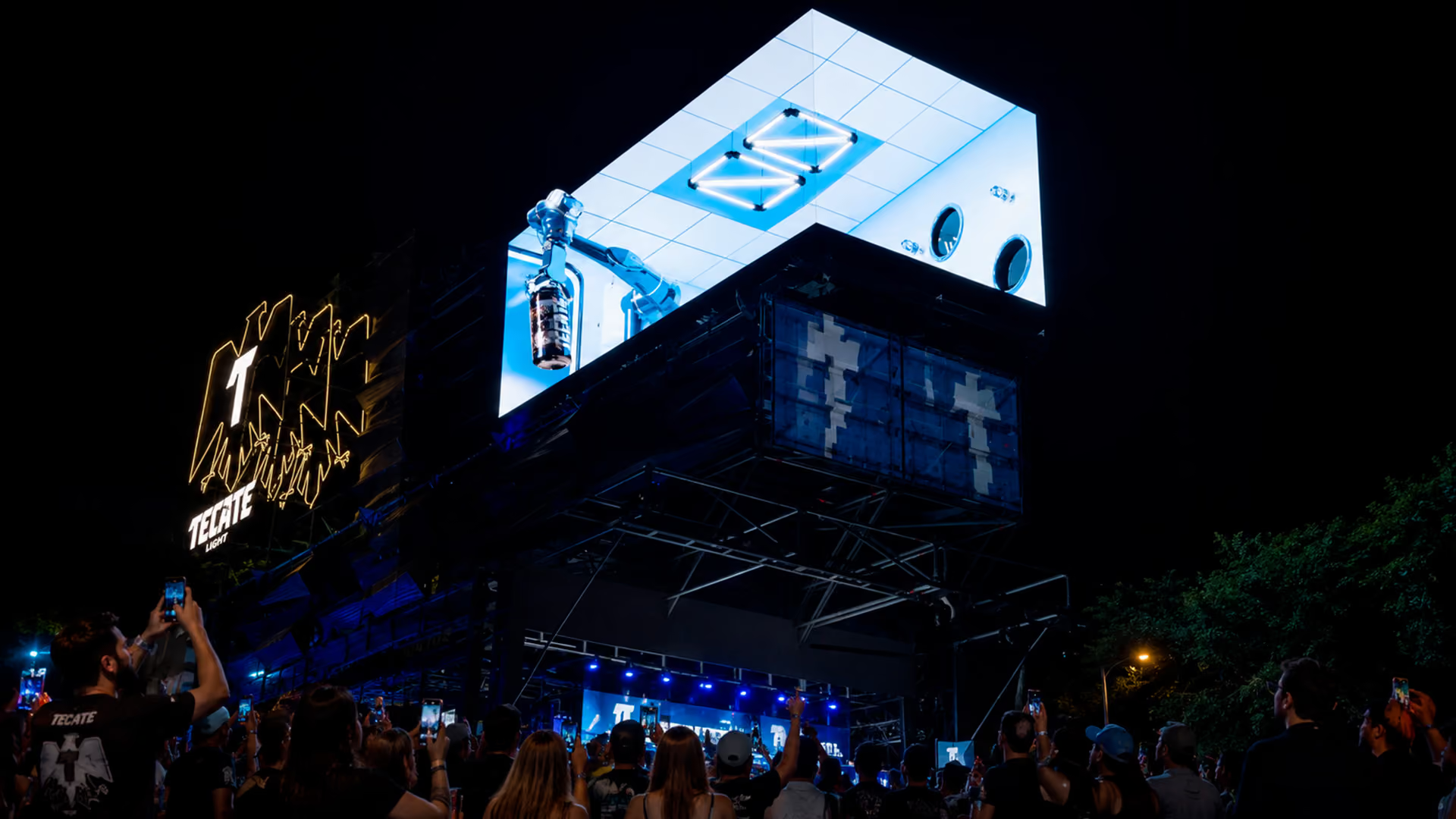
In the anamorphic content project for Tecate, Cinética Studio developed 3D animation in Blender for large L-format LED screens. The case shows a specialized production capacity that can be incorporated within a broader campaign or production.
During a project, the specialized studio can provide technical information on the scope, timing, dependencies and limitations of the solution to facilitate coordination with the agency and the client.
Specialized capabilities that can be integrated into a production
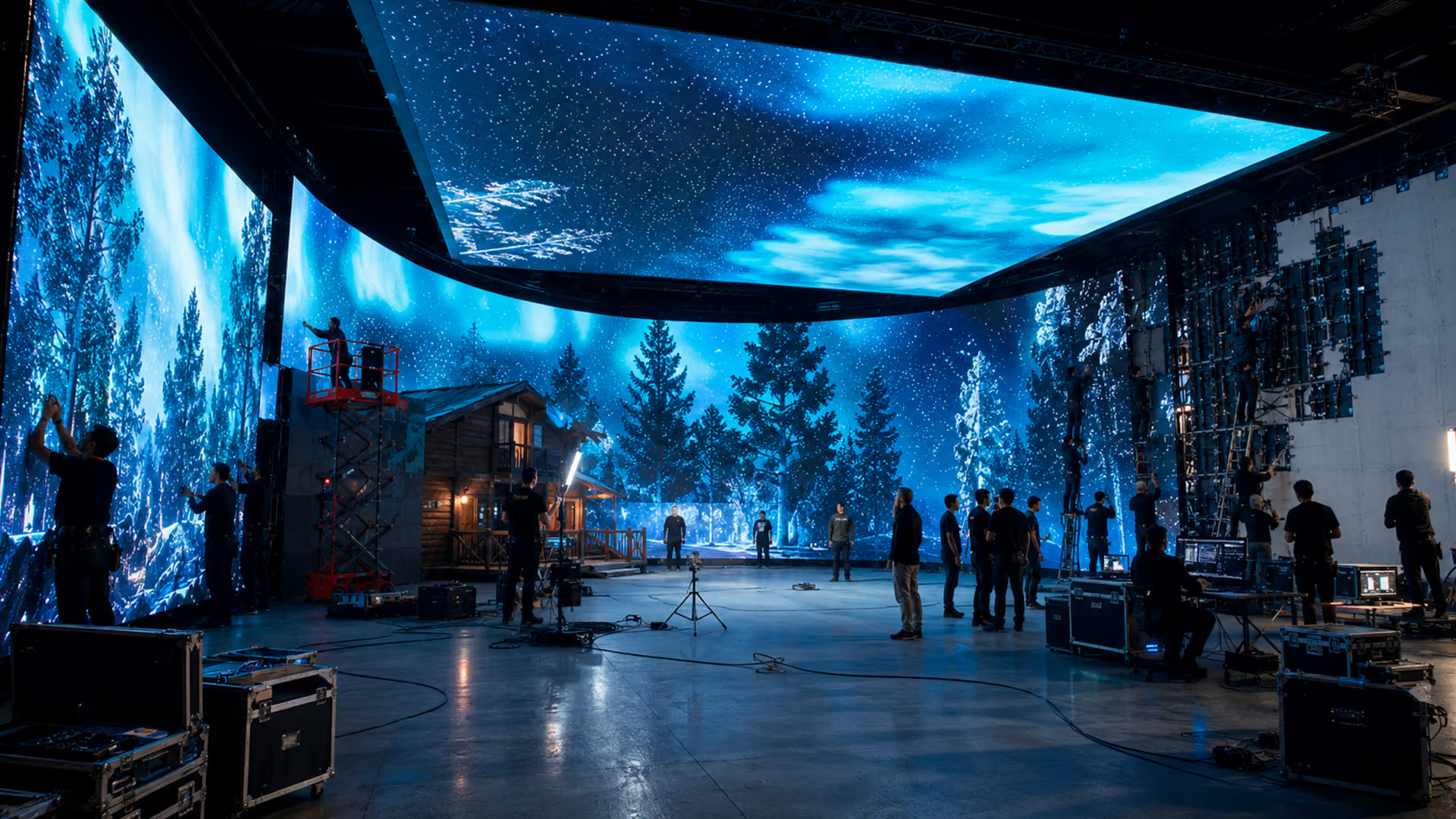
Specialized production can encompass very different disciplines and architectures. In a virtual production project for Aeroméxico, Cinética Studio developed virtual sets using Unreal Engine and integrated camera tracking and backgrounds displayed on LED screens for an audiovisual production.
In FOOH projects for brands such as Duolingo, Padge and Intel, the production flow included asset creation and 3D animation in Blender, VFX tracking and integration in Nuke, on-location image surveying and sound design.
For a YouTube event aimed at content creators, Cinética Studio developed a photo opportunity that integrated TouchDesigner with a flow based on Stable Diffusion and SDXL to generate visual variations related to musical profiles selected by participants.
These cases show capabilities that can be incorporated within broader production. They do not necessarily imply the same business model nor do they alone demonstrate that the recruitment was carried out through an agency.
Common mistakes when quoting external production and how to avoid them
Specialized creative production may require careful pricing and management. Identifying dependencies, scope, responsibilities and contingencies helps define clear conditions of collaboration.
One of the most frequent errors is the underestimation of time and resources. Projects such as virtual production, videomapping or interactive installations require pre-production, development and post-production phases that are not always linear. An agency that does not understand the technical complexity or workflow of an LED Volume, for example, may promise unrealistic deadlines to the client, creating unnecessary pressure on the specialized studio and compromising quality. The solution lies in early and detailed communication with the supplier, requesting realistic schedules and milestone breakdowns that allow for accurate planning.
Another common mistake is the failure to consider contingencies. In high-tech projects, technical unforeseen events, last-minute changes by the client, or logistical challenges may arise. Not including a margin for these eventualities in the initial quote can lead to cost overruns that the agency must absorb or cuts in scope that affect the bottom line. It is necessary to define how contingencies will be managed and what will happen when there is a change in scope. The amount or percentage reserved should be determined based on the level of uncertainty and risk of the project, rather than applying a universal figure.
Poor communication between the agency and the specialized studio is a constant source of problems. This can manifest itself in incomplete briefs, unclear expectations, or a lack of timely feedback. When working on complex projects such as developing interactive experiences with TouchDesigner and MediaPipe, such as the interactive floor that Cinética Studio developed for Coca-Cola, clarity of objectives and constant iteration are vital. To reduce coordination problems, it is advisable to define those responsible, communication channels, approval criteria and a process to record relevant decisions and changes. The structure must adapt to the size and complexity of the project.
Comparing proposals solely on price can hide differences in scope, support, licensing, testing, or infrastructure. Before choosing a supplier, equivalent conditions and defined technical criteria must be compared.
Featured in
Our work has been recognized by leading industry publications covering creativity, technology, and innovation.
Discover interviews, features, and articles that highlight our projects and perspective.


You may also like

Ready to create something extraordinary?
From concept to execution, we design experiences that connect people, technology, and storytelling in unforgettable ways.