Blog Post
How to Choose an Immersive Production Partner in Mexico That Can Actually Execute
Immersive production is expanding in Mexico: brands, museums, production companies, corporations, and industries are seeking experiences with video mapping, virtual reality, LED screens, XR, spatial audio, and real-time interaction. As the market grows, so does a key question: how do you distinguish a partner that can execute from one that only sells a visual promise?
June 2026.- Immersive production in Mexico is entering a more demanding stage. The concept is no longer limited to virtual reality, wraparound screens, or spectacular projections. Today it can integrate virtual production, video mapping, LED screens, spatial audio, sensors, live data, show-control systems, real-time engines, and applied artificial intelligence.
That growth creates an opportunity for brands, agencies, museums, production companies, and corporate teams. It also raises a critical question: how do you choose an immersive production partner that can truly execute when the idea stops being a render and becomes a venue, an audience, electricity, network, sensors, screens, audio, and live operation?
The answer is not found only in a creative portfolio. A reel can show a final result, but it does not necessarily explain the layers that held the experience together: site survey, technical design, hardware, software, power, network, calibration, safety, permits, testing, redundancies, and on-site crew.
An immersive experience is not purchased like a video, and it is not solved only with a screen, a projector, a headset, or an app. It is produced as a system. In that system, professional value appears in the ability to integrate content, space, sound, interaction, technology, operation, and safety under one methodology.
For Cinetica Studio, this approach is central: immersion works when creativity can be translated into a clear, operable, and safe technical architecture. The idea is only the beginning. The experience is validated when everything is calibrated and works in front of the audience.
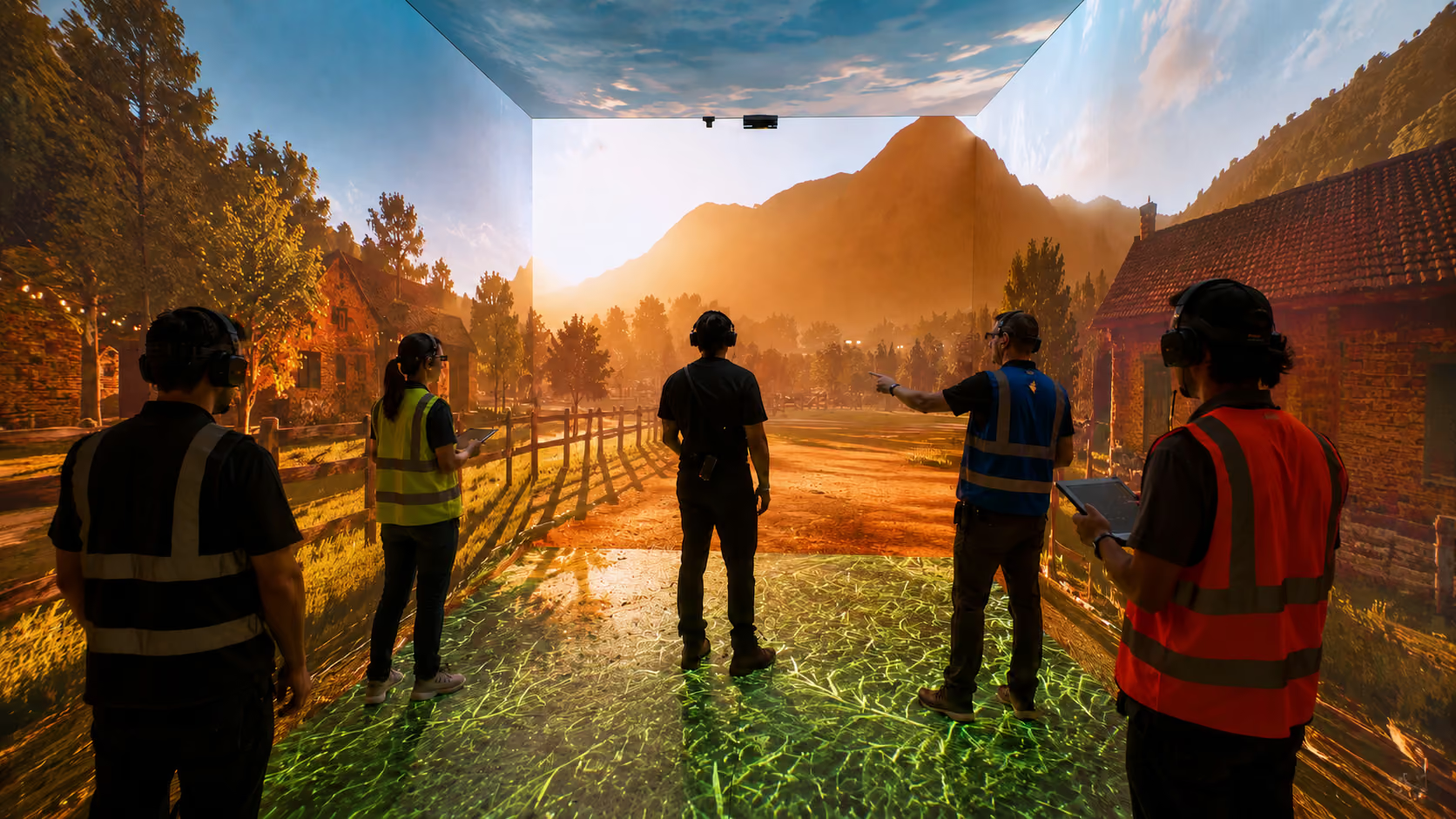
Immersion is not a screen. It is a system.
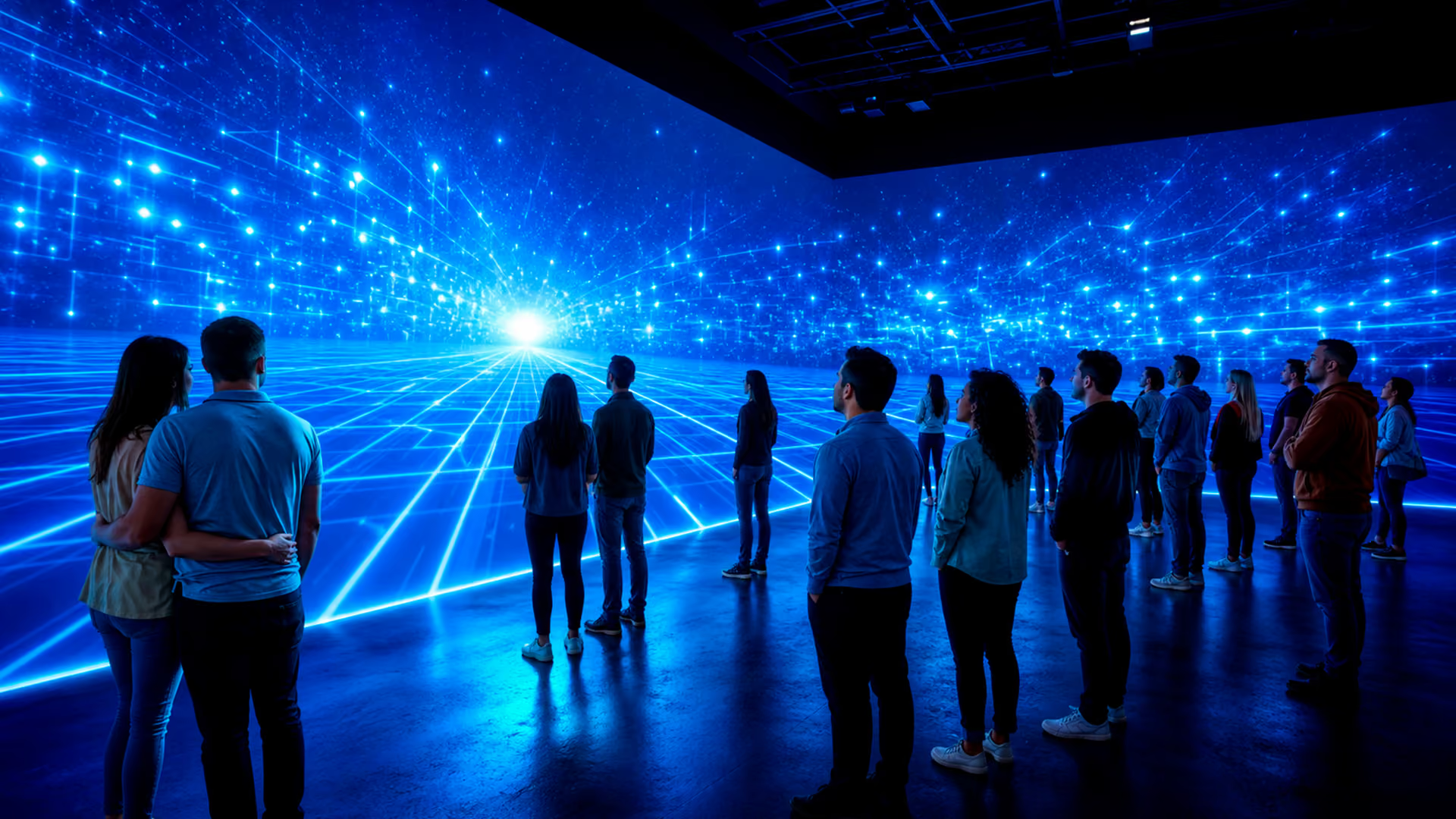
An immersive production is an experience in which the user does not simply observe content. They enter a spatial, visual, sonic, and sometimes interactive system. It can happen inside a museum, a film set, a corporate venue, a store, a trade show, a public plaza, a VR room, or a temporary installation.
The experience may include wraparound LED screens, LED volumes, 360 projection, video mapping on architecture or objects, virtual reality, augmented reality, mixed reality, motion sensors, body tracking, facial tracking, immersive audio, engines such as Unreal Engine, Unity, or TouchDesigner, media servers, AV-over-IP, cameras, LiDAR, RFID, NFC, computer vision, generative AI, or procedural content.
But none of those layers guarantees immersion on its own. A large screen can be just a large screen. A headset can be just an interface. A spectacular render may not survive installation. Immersion appears when the layers work together so the person feels they are entering an environment, not merely looking at a surface.
From Cinetica Studio's practice, a tool only adds value when it is connected to the intention of the experience: what it should provoke, how it is activated, how it is sustained live, and what the audience remembers after leaving the space.
That is why the hiring conversation should not begin with the tool. Instead of saying "we want VR," "we want AI," or "we want something futuristic," it is better to define what the person should do inside the space, what they should feel, what they should remember, and what role technology must play in the experience.

Why this matters now in Mexico
Mexico is no longer only a consumer market for immersive experiences. The local ecosystem is starting to combine virtual production, XR, mapping, digital museography, interactive activations, industrial training, and immersive brand content. That forces the hiring process to become more professional.
For Cinetica Studio, the maturity of the market also changes the conversation with brands. It is no longer enough to request a visually impressive piece. Teams must review methodology, operation, and the real capacity to take an experience from concept to site.
Signals of maturity are visible across several fronts: local virtual production infrastructure, XR studios in Mexico City, companies focused on VR and AR for industry, and cultural immersive exhibitions that bring these formats to broader audiences. At the same time, the global Pro AV industry is being transformed by the experience economy, AV-over-IP, software, cloud, AI, and XR. In that context, immersive experiences are no longer understood only as spectacle. They are becoming part of how brands educate, sell, launch, train, and build memory.
What a capable partner should be able to answer
A serious partner should be able to speak about the creative idea and the operational conditions with the same clarity. The questions are not only aesthetic. They are practical: where does the audience enter? How long does the journey take? How many people can be inside at once? Where are the screens placed? What is the throw distance? What power is available? What happens if the internet fails? Who restarts the system? How is the content updated? What is measured? What data is not collected?
A partner who can execute should ask uncomfortable questions early. That is not a lack of creativity. It is a sign of responsibility. Immersive production becomes expensive when assumptions are discovered too late.

Key evaluation criteria
- Methodology: The partner should show how the project moves from discovery to design, previsualization, technical development, testing, installation, operation, and documentation.
- Technical design: They should understand hardware, software, signal flow, power, networking, synchronization, calibration, audio, environmental conditions, and safety.
- Content pipeline: Immersive content must be designed for the actual format, resolution, surface, pixel pitch, projection geometry, frame rate, and playback system.
- Real-time integration: If the project uses interaction, sensors, AI, data, or generative visuals, the partner must explain latency, fallback states, moderation, and operating logic.
- On-site operation: The team should define run of show, crew roles, monitoring, maintenance, restart procedures, and escalation paths.
- Risk management: The partner should design for failure, not simply promise that nothing will fail. Redundancy, offline modes, spare parts, and recovery flows matter.
- Measurement: The experience should define useful metrics, not vanity metrics. Participation, dwell time, completion, repeat use, content generated, satisfaction, and operational learnings may be more relevant than raw impressions.
The portfolio is not enough
A portfolio can show taste, ambition, and production value. It cannot prove everything. When hiring an immersive partner, brands should ask what each project required behind the scenes. How many days of setup? What technical constraints? What failed during testing? How was it solved? What was reusable? What did the team learn?
A partner that can only talk about the final image may be selling an aesthetic. A partner that can explain process, constraints, and decisions is more likely to protect the project when it reaches site.
The best question is not "have you done something like this?" It is "how would you make this survive our real conditions?" A museum has different needs than a trade show. A brand launch has different pressure than a permanent installation. A pop-up in a mall has different risks than a controlled studio shoot.

From render to venue
The gap between render and venue is where many immersive projects lose quality. A render assumes ideal camera angles, clean surfaces, perfect lighting, no cable runs, no crowd behavior, no venue restrictions, and no one asking for a last-minute change. The venue introduces everything the render removed.
This is where technical preproduction becomes essential. Site surveys, measurements, equipment lists, signal diagrams, power requirements, structural considerations, content maps, rehearsal plans, and approval milestones protect the creative idea. They do not make the project less ambitious. They make ambition executable.
Questions brands should ask before hiring
- What is your process from brief to live operation?
- Who is responsible for creative direction, technical direction, software, hardware, content, and on-site support?
- What information do you need from the venue before quoting accurately?
- What assumptions are included in the proposal?
- What are the main technical risks and how would you mitigate them?
- What happens if a sensor, computer, projector, screen, or network fails?
- What tests will happen before the audience arrives?
- How will the experience be measured?
- What deliverables will remain after the event?
- What does the client need to decide early to avoid costly rework?
Common warning signs
A weak partner often avoids technical detail, quotes before understanding the venue, promises "anything is possible" without conditions, treats AI or XR as a magic layer, ignores operation, or does not discuss fallback states. Another warning sign is confusing equipment rental with experience production. Renting hardware is not the same as designing a working system.
There are also creative warning signs: using immersion as a synonym for "big," adding interaction without a user reason, designing content that only works from one camera angle, or assuming the audience will read long instructions.
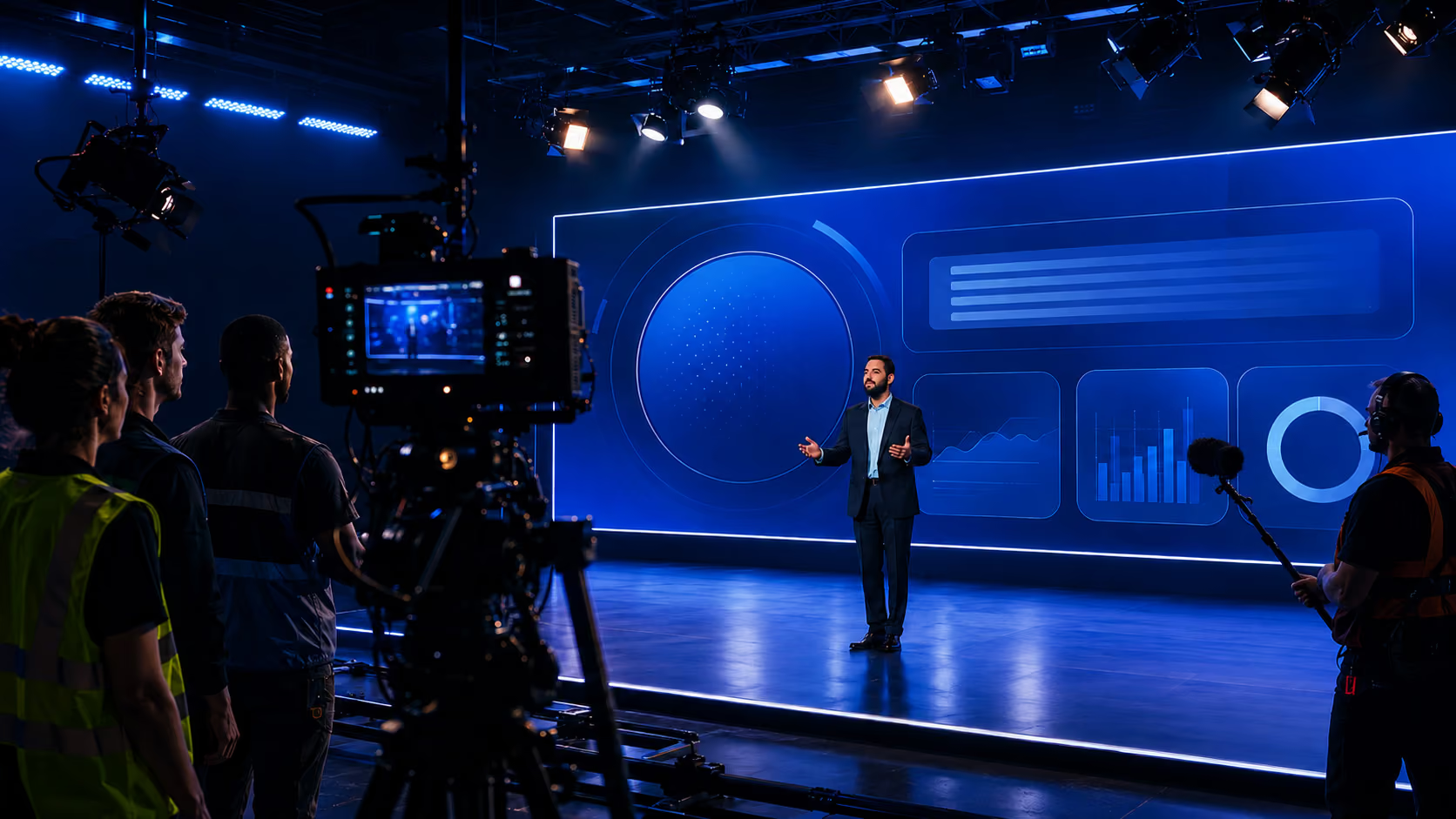
What Cinetica Studio looks for in a good brief
A strong brief does not need to solve the production before the studio begins. But it should define the business objective, target audience, venue or expected space, timeline, desired behavior, brand constraints, data policies, success metrics, and operational expectations.
The more clearly the situation is defined, the more accurately a partner can recommend technology. Maybe the right answer is a passive LED environment. Maybe it is an interactive system. Maybe it is video mapping, VR, XR, a virtual production setup, or a hybrid workflow with generative AI. The decision should come from the experience, not from the trend.
The right partner protects the idea
The role of an immersive production partner is not to make a render look impressive. It is to protect the idea across space, technology, people, time, and risk. That requires creative sensitivity, technical rigor, and operational discipline.
In Mexico, the opportunity is large. Brands are asking for more ambitious experiences, and audiences are more willing to enter spaces where content becomes physical, responsive, or participatory. But the market will reward the teams that can execute, not just imagine.
Choosing the right partner means asking who can translate a brand intention into a system that works live, with real people, under real conditions. That is where immersive production becomes more than spectacle. It becomes experience.

Featured in
Our work has been recognized by leading industry publications covering creativity, technology, and innovation.
Discover interviews, features, and articles that highlight our projects and perspective.


You may also like
Ready to create something extraordinary?
From concept to execution, we design experiences that connect people, technology, and storytelling in unforgettable ways.