Blog Post
Beyond the screen: how to evaluate a building for videomapping
The Anatomy of a Canvas: What Makes a Surface Suitable for Video Mapping
Not all surfaces offer the same conditions for a videomapping project. Its feasibility depends on factors such as geometry, material, color, reflectance, ambient lighting, available positions for projectors, and public viewing areas.
These variables must be analyzed together before defining the projection system and producing the content.
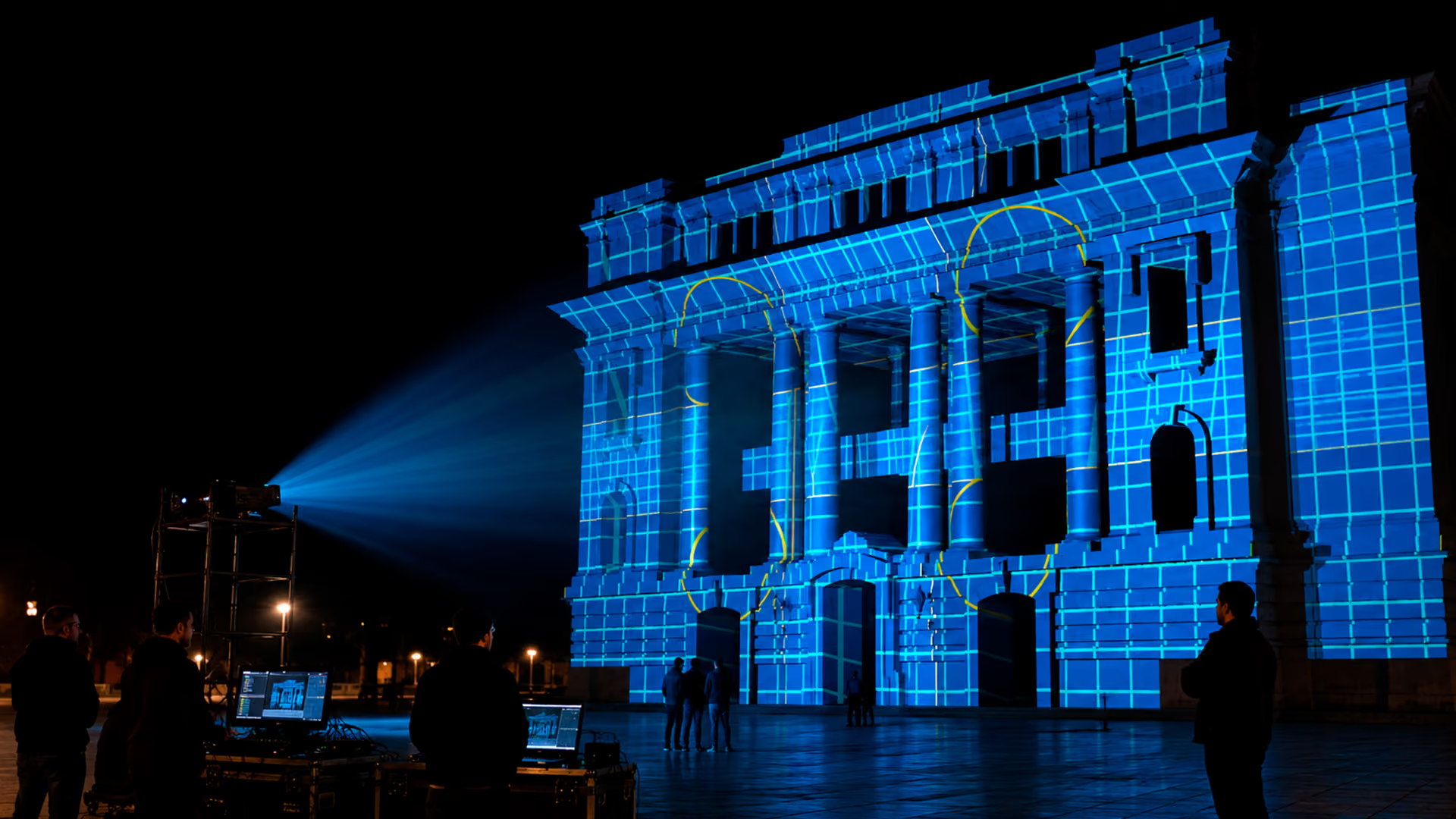
In videomapping, the production system adjusts content and projection to align with the geometry of a surface. This process may include space modeling or surveying, projector positioning, calibration, and image deformation.
Alignment is not automatically perfect and may require adjustments during assembly. Manual and camera-assisted calibration systems exist to relate projectors to three-dimensional space.
The appearance of a projection depends on how the surface reflects light. Color, texture, finish and geometry can modify perceived brightness, contrast and color rendering.
Surfaces with specular reflections can produce bright areas dependent on the viewing angle, while a dark surface can reduce the amount of light reflected back to the audience. These conditions must be evaluated in conjunction with the ambient lighting and projection system.
Three-dimensional geometry can provide creative resources, but it also introduces projection challenges. Protrusions, indentations, balconies, and other elements can be used as part of the content, but they can also produce occlusions, shadows, or areas that require other projection angles. Content can use architectural features as references to construct depth, movement, or transformation effects. The effectiveness of these illusions depends on the alignment between geometry, viewing perspective, projection, and content layout.
Key architectural factors: Shape, texture and color
The shape, texture and color of a facade influence the technical feasibility and visual result of a video mapping. These factors must be evaluated before defining a proposal and the projection system.
The shape of the façade is the starting point. Surfaces with complex geometry, multiple planes, indentations and protrusions, or pronounced decorative elements can be both a challenge and an opportunity. A relatively flat and uniform façade facilitates image calibration and distortion, allowing for sharp and precise projections. However, three-dimensional elements can be creatively exploited to generate optical illusions, depth and movement, transforming architecture into a dynamic sculpture. The key is to understand how each relief, window or column will interact with the projected light and whether these details will enrich or distort the desired effect.
The texture of the surface is another determining factor. Light surfaces with a relatively uniform finish tend to make it easier to reproduce a projected image, while surfaces that are dark, highly textured, or have uneven reflectance can affect the result.
The solution is not automatically to use a projector with a higher luminous flux. Coverage, ambient light, optics, contrast, distance and audience positions should also be evaluated.
The inherent color of the façade modifies the perception of the projection. A light surface can facilitate color reproduction, while a dark surface or one with dominant tones can alter the reflected light. Therefore, content may require color compensation and on-site testing. In Cinética Studio, previewing and adjustment are integrated into development when the scope of the project requires it.
Environment matters: Ambient light and obstacles
In addition to the architectural surface, the surrounding environment must be evaluated. Ambient light and physical obstacles can change the contrast, coverage, and visibility of a projection.
Natural light, especially during twilight and night, is the first challenge. Ambient light reduces the perceived contrast of a projection, so lighting conditions must be analyzed during planning. Outdoor projections usually benefit from nighttime conditions or greater lighting control, although viability during the day depends on the size of the surface, the incident lighting, the projection system and the required contrast. However, even after dark, the city's artificial light can be a problem. Streetlights, illuminated signs, storefronts, and vehicular traffic can generate significant light pollution that "washes out" the projection, reducing its brightness and saturation. During the technical reconnaissance, the lighting sources that directly affect the projection surface must be identified and the conditions expected for the time of the event must be documented.
Physical obstacles add complexity. Trees, poles, street furniture, cables, balconies or other buildings can block the light path or public visibility. During the location reconnaissance these elements must be identified. The answer may include changing projector positions, using more than one angle, or adapting content to available areas. These decisions reduce risks, but do not guarantee a projection without visual interruptions.
Projection distance and angle: The perspective of the viewer and the projector
The effectiveness of videomapping depends critically on the spatial relationship between the projector, the surface and the audience. It is not enough to have an adequate surface; The distance and angle of projection are decisive for the visual quality and immersion of the experience. An accurate evaluation of these factors is essential to avoid distortions, ensure image sharpness, and ensure that the visual message is perceived as intended.
The position of the projector and lens determine what size image can be covered from a given distance. The throw ratio relates the projection distance to the image width and should be checked for the model and lens selected.
Distance alone does not determine final quality. Surface coverage, available luminous flux, optics, focus, resolution, and ambient lighting should also be evaluated.
The angle of incidence of the projection is equally crucial. A more frontal position can reduce certain geometric deformations, but the final location depends on the architecture, optics, required coverage, lines of sight and available areas to install the equipment. When the projector is positioned at an oblique angle, the image is warped, requiring complex software corrections to "map" the digital content to the actual geometry of the building. These corrections, while powerful, can affect resolution and sharpness if the angle is too extreme. A 3D representation of the surface can be used during pre-production to evaluate projector positions, angles, and coverage prior to assembly.
In addition to the projector-surface ratio, the viewer's perspective is an often underestimated factor. The ideal audience location should allow a clear view of the mapped surface, without obstructions, and from an angle that maximizes visual impact. A video mapping designed to be viewed from a fixed point will not have the same effect if the audience moves freely or observes it from very open angles. It is vital to define preferred viewing areas and ensure that the projection is legible and aesthetically consistent from those points. This involves considering the height of the spectators, the presence of urban elements or furniture that may block the view, and the distance at which they will be to appreciate the details of the mapping. Planning viewing areas helps identify from which positions the content can be viewed with the intended layout.
Technical considerations: Light power and resolution
Videomapping requires adequate technical infrastructure. Luminous flux and resolution are relevant variables, but should be evaluated along with surface, optics, contrast, ambient lighting, and viewing positions.
The luminous flux of the projector, expressed in lumens, influences the visibility of the projection. The result also depends on the area covered, ambient lighting, reflectance, contrast and optics used. To select the system, coverage, throw ratio, optics, number of projectors and expected lighting conditions must be calculated.
Additionally, image resolution is essential for the clarity and detail of the projection. Just as a high-definition television offers a sharper image than a standard-definition one, high-resolution video mapping allows you to appreciate fine textures, smooth transitions and complex graphic elements. The resolution must be appropriate to the size of the surface and the viewing distance of the audience. Projecting a low resolution image onto a very large surface will result in a pixelated and unprofessional image. The resolution should be defined according to the size of the surface, the number of projectors, the area covered by each image and the viewing distance. A higher resolution does not by itself guarantee a better result if there are problems with focus, alignment, contrast or visibility.
Elements that require legibility, such as text or logos, should be tested from areas intended for the public.
Logistics and security: Access, energy and permits
In addition to aesthetic and technical considerations, the viability of video mapping depends on logistics and safety. These elements can affect the schedule, budget and operating conditions.
Access to the location should be evaluated to determine if projectors, support structures, generators and wiring can be safely transported and installed. Ramps, elevators, stairs and loading capacity must be considered. At Cinética Studio, technical visits can include the recognition of access and exit routes before defining the assembly plan.
The availability of electrical energy is another critical pillar. High-power projectors, along with media servers, control systems and complementary lighting equipment, demand a considerable amount of energy. It is essential to verify the capacity of the existing electrical infrastructure in the location. Are there adequate power outlets? Is the power enough? In many cases, especially in historic buildings or open spaces, it is necessary to resort to external generators, which adds a layer of logistical and permitting complexity. Planning includes wiring layout to avoid trip hazards and ensure public and staff safety.
Obtaining permits should not be overlooked. Video mapping in public spaces or emblematic buildings may require municipal authorizations, permits for temporary installations, civil protection requirements and owner consent where applicable. The requirements depend on the jurisdiction and must be confirmed with the authorities and those responsible for the property.
Technical evaluation of a surface
Before producing the content, it is advisable to carry out a technical reconnaissance of the location. The evaluation may include measurements of the surface, materials, light sources, obstacles, available positions for projectors, electrical supply, audience areas and mounting routes.
Depending on the complexity, a 3D model or simulation can also be used to study the coverage and positions of the projectors before installation. The information collected allows us to reduce uncertainty and define which aspects will still need to be validated during on-site testing.
Cinética Studio cases: different surfaces for projection
At Santa’s Lab, Cinética Studio developed an experience in which 3D animations were projected on tables using 4K projectors. The project used TouchDesigner for the operation of the show and shows how a horizontal surface can be part of an audiovisual setting when the content and system are designed for its geometry.
At Nescafé Viaje Sensorial, Cinética Studio developed an immersive experience that included an activity in a room with video mapping to present content about the history and production process of coffee. The project shows a projection application within an interior space.
These projects do not allow us to conclude that any surface is suitable for videomapping. Each implementation requires evaluating the geometry, light, optics, equipment position and operating conditions.
Featured in
Our work has been recognized by leading industry publications covering creativity, technology, and innovation.
Discover interviews, features, and articles that highlight our projects and perspective.


You may also like
Ready to create something extraordinary?
From concept to execution, we design experiences that connect people, technology, and storytelling in unforgettable ways.