Blog Post
Beyond the Hype: Selecting the Ideal Sensor for Your Interactive Project with a Strategic Vision
Sensors for Interactive Experiences: The Definitive Guide to Choosing Without Overengineering
The Strategic Importance of Detection in Immersive Experiences
In the dynamic field of immersive experiences and brand activations, the ability to detect and respond to the presence or movement of users lies at the heart of interactivity. It is not simply about capturing data, but about transforming that information into a fluid and engaging narrative that resonates with the audience.
Choosing the right sensor—whether an RGB camera, a depth sensor, or a LiDAR system—is not a minor technical decision. It is a strategic choice that directly affects the feasibility, cost, and final quality of the experience.
An appropriate selection helps make the interaction more intuitive and fluid, improves the user experience, and can contribute to the activation achieving its communication objectives more effectively.
On the other hand, a poor decision can result in overengineering: implementing technology that is more complex or expensive than necessary, or using a solution that does not match the project’s specific requirements.
This not only increases costs and development time, but can also result in a suboptimal interactive experience that frustrates users and fails to support the marketing objectives effectively.
Detection is the bridge between the physical and digital worlds in an interactive installation. It is what enables a floor to respond to every step, a wall to react to touch, or a projection to adapt to a person’s position.
For example, when Cinetica Studio developed an interactive floor for Coca-Cola, the key was detecting and tracking people in real time using webcams and computer vision.
This technology allowed the generative graphics displayed on the floor to change fluidly according to the movement and number of users, creating a dynamic and immersive visual experience without requiring sensors that were unnecessarily complex for the specific objective.
Understanding the capabilities and limitations of each sensor type is crucial for avoiding common mistakes. Not every experience requires the millimeter-level accuracy of LiDAR, and not every project can be solved with the simplicity of an RGB camera.
The key is to align the detection technology with the intended interaction, the installation environment, and the available budget.
This strategic approach ensures that every technological component contributes to the final result without adding unnecessary complexity.
RGB Cameras: Versatility and Accessibility for Basic Detection
RGB cameras—the same type found in smartphones and webcams—are often the most accessible and versatile starting point for detection in interactive experiences.
Their main advantage is their low cost and ease of integration, making them an efficient option for projects in which motion detection and basic interaction are sufficient.
These cameras capture visual information within the visible-light spectrum, allowing computer-vision systems to identify shapes, colors, and movements.
Within immersive experiences, RGB cameras are commonly used to track people, detect simple gestures, or activate visual content based on the presence of a user.
Through computer-vision algorithms, the video feed can be processed in real time to count the number of people within an area, determine their approximate position, or recognize predefined movement patterns.
Their implementation is relatively straightforward, accelerating development times and reducing technical complexity, especially in projects with limited budgets or short delivery schedules.
A clear example of their application can be found in the development of interactive floors.
At Cinetica Studio, we have implemented solutions in which RGB cameras, combined with software such as MediaPipe and TouchDesigner, detect landmarks, silhouettes, or the approximate positions of users within the camera frame, depending on the calibration and processing method used.
This allows real-time generative graphics to change and react to people’s movements, creating a dynamic and immersive visual experience.
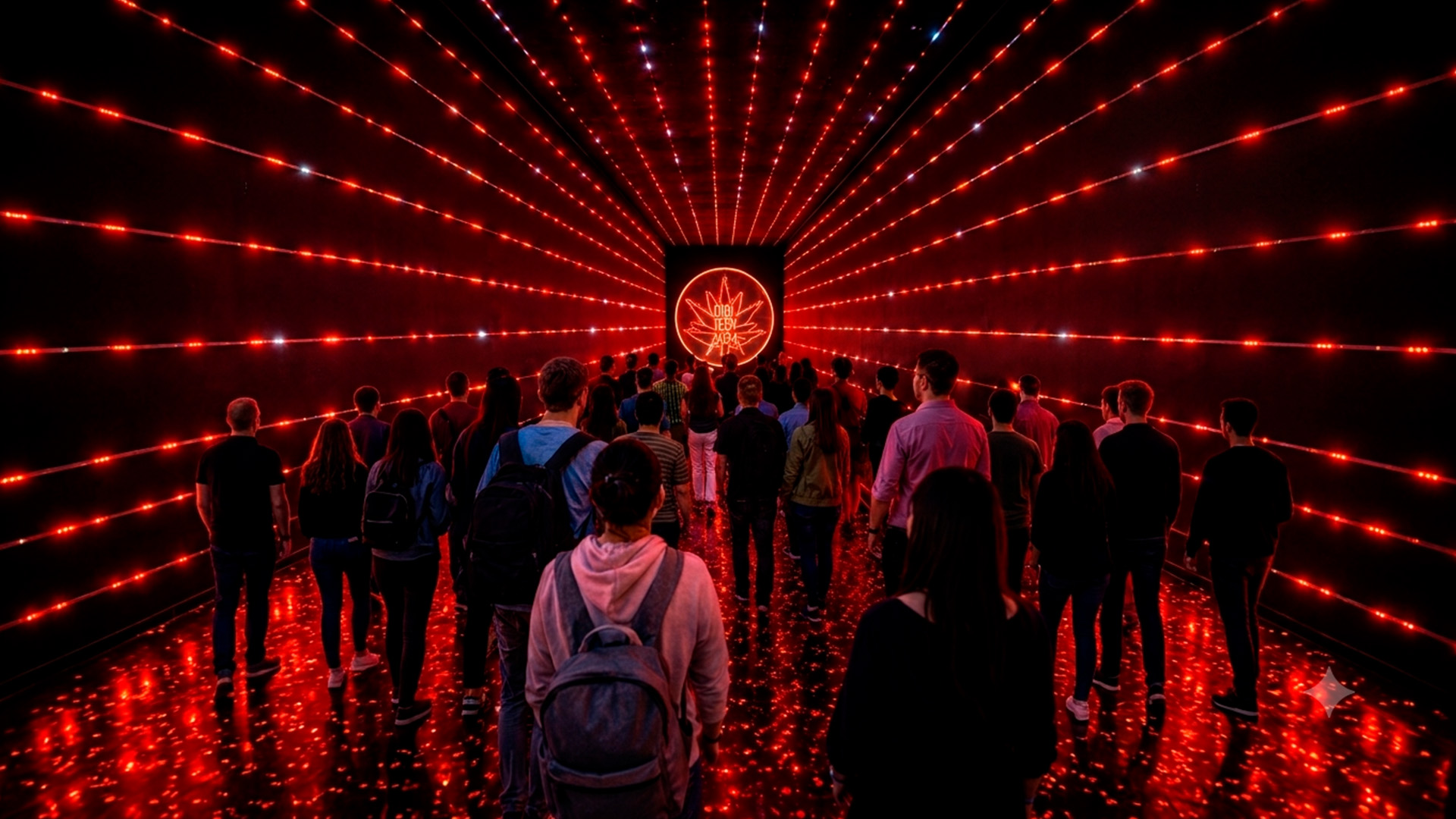
One specific Coca-Cola project involved an interactive floor in which the visuals changed as people moved through a tunnel. The RGB camera captured their movements, while computer vision analyzed their position and displacement to create a fluid interaction.
Another practical use case is the detection of interactions within booths or individual stations.
For Amazon Music, Cinetica Studio developed an interactive karaoke experience in which a webcam—a standard RGB camera—captured video of the participants.
Although the primary objective was to record audio and video in order to generate a final clip, the RGB camera was essential for capturing the visual performance, demonstrating its ability to integrate into more complex systems that require a basic but effective visual input.
In both examples, choosing RGB cameras made it possible to create engaging experiences without incurring the complexity or cost of more advanced sensors, validating their role as a fundamental tool within the creative-technology toolkit.
Depth Sensors: A Step Forward in 3D Interactivity
While RGB cameras capture two-dimensional information, depth sensors represent a qualitative leap by adding a third dimension to the perception of space.
Popularized by technologies such as Microsoft Kinect and Intel RealSense, these devices not only detect the presence of an object or person, but also measure how far away they are, creating a three-dimensional map of the environment.
This capability opens up a broad range of possibilities for more sophisticated and natural interactions.
The technology behind depth sensors varies, but it may commonly be based on Time-of-Flight, structured light, or active or passive stereo vision, depending on the model and manufacturer.
The result is generally a depth map that, depending on the processing workflow, can be converted into a point cloud used to estimate the geometry of the space and the relative position of elements within it.
This is essential for applications that require person segmentation, complex gesture detection, or even real-time human skeleton tracking.
The advantages of depth sensors are significant.
They can offer greater robustness against certain changes in lighting when compared with RGB cameras, although their performance depends on the sensor type, ambient infrared light, the surfaces being detected, and the installation conditions.
Their ability to distinguish depth also dramatically reduces false positives and enables more precise interactions, such as detecting when a user approaches a virtual object or differentiating between two people who overlap within the camera’s field of view.
This accuracy is essential in experiences where the interaction must feel intuitive and frictionless.
However, depth sensors also have limitations.
Their effective range is generally more limited than that of RGB cameras, and their depth resolution can be affected by reflective surfaces or materials that absorb infrared light.
Processing depth data is also more computationally intensive, requiring more powerful hardware to maintain a fluid experience.
Despite these challenges, their value in the creation of immersive experiences is undeniable.
At Cinetica Studio, we have used the capabilities of depth sensors to create highly responsive interactions.
A clear example was the development of an interactive floor for Coca-Cola, where we used cameras with depth-detection capabilities and computer vision.
The system not only detected the presence of people within a corridor, but also tracked their position and movement in real time.
This allowed the generative floor graphics to change fluidly and immersively according to the movement and number of users, transforming a simple passageway into a dynamic visual experience.
The precision of the depth sensor was essential for enabling the visuals to follow each person’s route individually, increasing the level of interactivity and surprise.
LiDAR: High Precision and Advanced Spatial Mapping
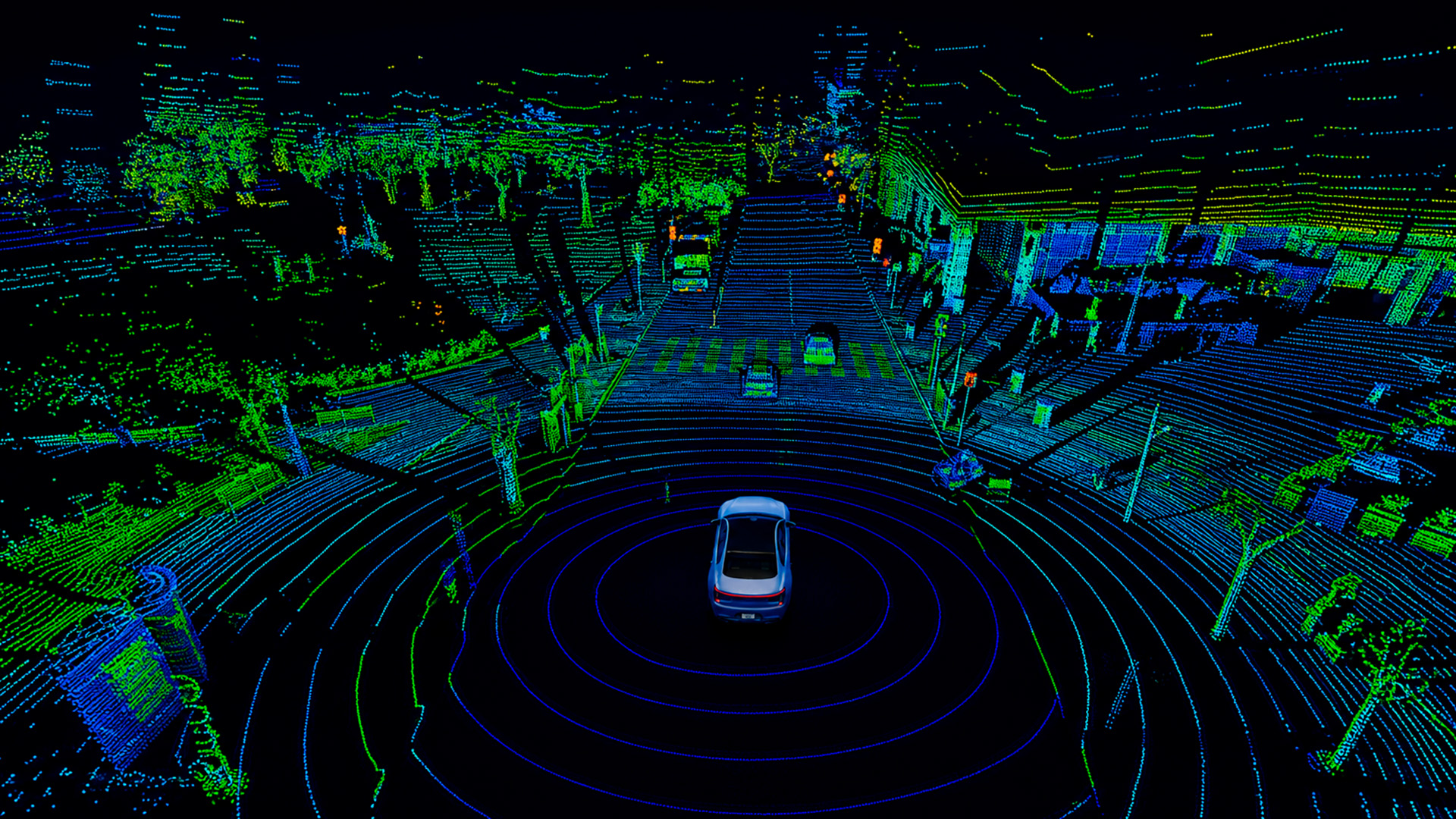
A LiDAR sensor can be understood as a scanner capable of reading a space in three dimensions through pulses of light.
In the context of autonomous mobility, for example, it is often compared with systems such as those used by Tesla, which interpret their surroundings in order to identify vehicles, people, distances, and obstacles.
The difference is that, while Tesla has primarily relied on cameras and computer vision, LiDAR performs this spatial reading by directly measuring the distance between the sensor and the objects surrounding it.
LiDAR operates according to the Time-of-Flight principle, similar to some depth sensors, but with significantly greater range and resolution.
Each measurement can generate a point in space, and the accumulation of these points makes it possible to build a digital model of the environment at varying levels of detail, depending on the system’s resolution, frequency, and configuration.
This capability makes LiDAR invaluable for applications that require a comprehensive understanding of physical space, including autonomous navigation, surveying, and, within our field, large-scale and highly complex interactive installations.
LiDAR’s primary advantage is its ability to operate reliably in many conditions where visible light is limited, as well as its reduced dependence on the color or texture of surfaces compared with other vision systems.
This makes it a robust tool for projects where consistency and accuracy are essential.
However, this sophistication comes at a price: LiDAR systems are generally more complex and expensive to implement than RGB cameras or depth sensors, meaning that the investment must be clearly justified.
At Cinetica Studio, we have used LiDAR in projects that require precise interaction with complex surfaces and volumes.
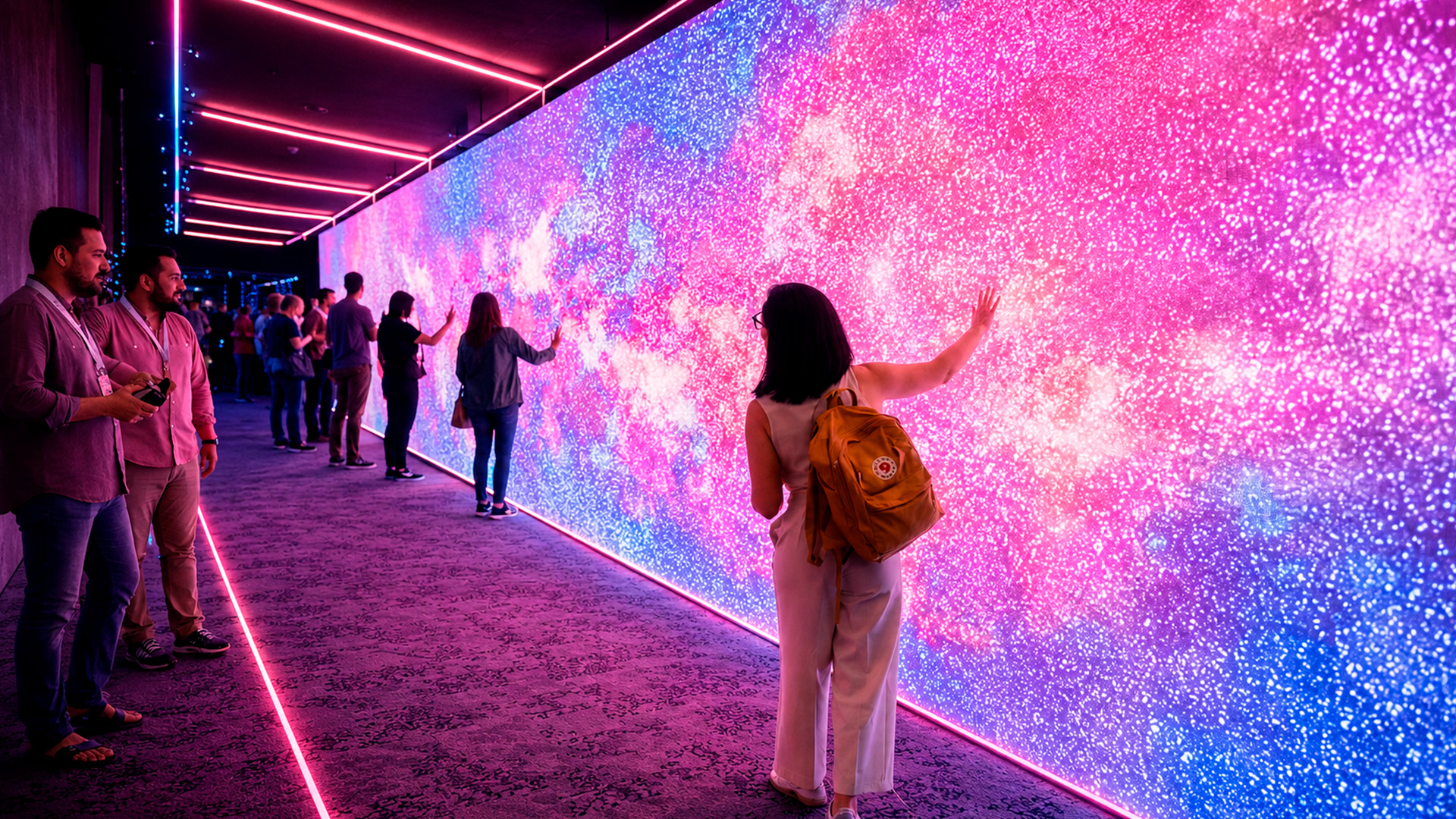
For example, during one of our collaborations with Nestlé for the NAN brand, we developed an immersive room in which an interactive wall responded to the touch and proximity of children.
LiDAR was essential for detecting interactions on the surface of the wall, interpreting contact or proximity points with the accuracy required to create a fluid and responsive experience.
Communication between the LiDAR system and the interactive application, developed using Unity and TouchDesigner, ensured that each movement translated into an immediate visual response, transforming science into a playful and educational experience.
The decision to incorporate LiDAR is justified when an experience requires dynamic spatial mapping, highly accurate detection of multiple users across a large area, or very specific interaction with physical elements.
It is the appropriate choice when overengineering is not a luxury, but a necessity for achieving the desired level of immersion and reliability.
At Cinetica Studio, LiDAR is selected only after a thorough analysis of the project requirements, ensuring that its implementation is not only technically viable, but also strategically aligned with the brand’s objectives and the intended user experience.
This allows us to deliver cutting-edge solutions that maximize the impact and memorability of each activation.
Key Criteria for Sensor Selection: Avoiding Overengineering
Choosing the appropriate sensor for an interactive experience is not about selecting the most advanced or expensive technology. It is about selecting the solution that best aligns with the project objectives, environmental conditions, and available budget.
The key is to avoid overengineering—that is, implementing solutions that are excessively complex or powerful for needs that could be addressed with simpler and more efficient tools.
Several criteria should be considered to guide this decision.
The first factor is the desired type of interaction.
Do we need to detect the presence of a person, their general movement, specific gestures, or the position and orientation of objects in three-dimensional space?
A basic interaction, such as activating content when somebody walks past, may only require an RGB camera and computer-vision algorithms.
When the experience requires users to manipulate virtual objects or interact with a reactive floor—such as the system developed by Cinetica Studio for Coca-Cola using TouchDesigner and MediaPipe for person tracking—a depth sensor or even LiDAR may be more appropriate for reliable and accurate detection.
The conditions of the space are equally important.
The size of the detection area, ambient lighting, and the presence of obstacles all have a direct influence on the decision.
In environments with controlled lighting and limited space, an RGB camera or depth sensor may work effectively.
However, in large areas, outdoor environments, or spaces with variable and challenging lighting, LiDAR may offer greater robustness because it does not depend on visible light.
The complexity of installation and maintenance must also be evaluated, as some sensors require more frequent calibration or specific supporting infrastructure.
Budget is, of course, another decisive factor.
RGB sensors are generally the most affordable, followed by depth sensors and then LiDAR, which usually represents the most significant investment.
It is essential to balance the required functionality with the available financial resources, seeking the most cost-effective solution that fulfills the expectations of the experience.
Investing in LiDAR for simple presence detection would be a clear example of overengineering.
Finally, data-processing requirements are a technical consideration that should not be overlooked.
Each sensor type generates different volumes and levels of data complexity.
RGB cameras produce images that require computer-vision algorithms to extract useful information.
Depth sensors add a layer of three-dimensional data, while LiDAR systems generate dense point clouds.
The hardware and software infrastructure required to process this information in real time, without perceptible latency for the user, must be considered from the beginning of the project.
Inefficient processing can compromise the fluidity of an experience, even when the most advanced sensor is being used.
Integration and Workflow: From the Sensor to the Final Experience
Once the appropriate sensor has been selected, the next critical step is integrating it into a workflow capable of transforming raw data into a fluid and meaningful interactive experience.
This process involves connecting the hardware to specialized software-development platforms, where the sensor information is interpreted and used to produce visual, auditory, or haptic responses in real time.
At Cinetica Studio, we use powerful tools such as TouchDesigner and Unity to orchestrate this transformation.
TouchDesigner is particularly effective for real-time data processing and the creation of generative graphics, while Unity provides a robust environment for developing complex 3D experiences and interactive logic.
The key is to establish efficient communication between the sensor and these platforms, often through network protocols or specific software development kits, allowing for minimal latency and high-fidelity data transmission.
The typical workflow begins with the sensor capturing data, such as the position of a body, the distance from a surface, or the presence of an object.
This information is sent to the development platform, where it is processed using customized algorithms.
For example, when a depth sensor detects a specific movement, the software can interpret it as a command to activate an animation, change a color, or reproduce a sound.
Optimizing this workflow is essential to ensuring that the experience is responsive and natural, without perceptible delays that disrupt the user’s sense of immersion.
A clear example of this integration is the interactive floor we developed for Coca-Cola.
For this project, we used webcams and computer vision to detect and track the movement of people inside a tunnel.
The position and movement information captured by the cameras was processed in real time using TouchDesigner, which then generated reactive visual graphics on the floor.
As users moved through the tunnel, the visuals changed, followed their paths, and responded fluidly to their movements.
This approach not only created an immersive experience, but also demonstrated how the appropriate sensor selection—in this case, webcams used for person detection—and expert software integration can bring complex interactive environments to life without relying on technology that is unnecessarily sophisticated for the specific requirement.
The ability to optimize this bridge between the sensor hardware and the experience software is what enables Cinetica Studio to design activations that are not only technologically advanced, but also intuitive and memorable for the final user.
Cinetica Studio Success Stories: Sensors in Action
The theory behind sensor selection becomes more tangible when examining its practical application in real projects.
At Cinetica Studio, we have implemented a variety of detection technologies, always with the objective of optimizing interactivity and immersion without falling into overengineering.
The key is to understand the specific needs of each project and select the tool that best aligns with them.
A clear example of how basic detection can generate an impactful experience is the interactive floor we developed for Coca-Cola.
The challenge was to create a dynamic visual experience inside a tunnel, where the graphics would react to the movement of people.
To achieve this, we integrated webcams and computer-vision techniques, specifically using MediaPipe for real-time person detection and tracking.
The decision to use webcams was strategic: they offered the versatility and accessibility needed to capture movement inside the corridor, allowing the visuals to follow the route of each user fluidly.
In this case, the sophistication did not lie within the sensor itself, but in the processing software that transformed the visual data into an immersive and reactive experience.
When the interaction required greater spatial precision and the ability to detect touch or proximity on surfaces, we turned to more advanced technologies.
One illustrative example is the series of interactive installations we created for Nestlé NAN.
During one of the stages, the objective was to transform a wall into an interactive surface where children could explore and learn about the microbiota.
For this purpose, we used LiDAR sensors, which enabled precise detection of interactions on the surface of the wall.
LiDAR not only detected contact or proximity points; its communication with TouchDesigner and Unity also ensured that every interaction was translated into a coherent and engaging visual response.
Surface calibration was essential in ensuring that the detection aligned perfectly with the visual content, creating an experience where science came to life through play.
These projects demonstrate that choosing a sensor is a strategic decision that directly affects the quality and feasibility of an experience.
It is not about using the most expensive or complex sensor, but selecting the one that best addresses the interactive challenge, optimizes resources, and guarantees a memorable result for the user.
The Future of Interactive Detection: Trends and New Possibilities
The field of interactive detection is constantly evolving, driven by advances in artificial intelligence, computer vision, and increasingly compact and powerful hardware.
Looking toward the future, several trends promise to further transform how brands interact with audiences in physical and virtual spaces.
One key direction is the fusion of data from multiple sensors to construct a more complete understanding of the environment and user behavior.
The combination of RGB cameras, depth sensors, and LiDAR can help detect presence, movement, proximity, body orientation, and interaction patterns, provided that appropriate models, user consent, controlled conditions, and a clear data-processing strategy are in place.
This multisensory integration opens the door to experiences that are more adaptive and contextual.
Artificial intelligence, particularly machine learning and neural networks, plays a crucial role in this evolution.
Algorithms are becoming increasingly capable of processing large volumes of sensor data in real time, identifying complex patterns that were previously impossible to distinguish.
This results in more robust detection that is less susceptible to errors, even in challenging environments with variable lighting or large crowds.
Generative AI could take interactivity to a new level by enabling experiences not only to react, but also to generate dynamic and unique content in response to each interaction, creating narratives that evolve alongside the user.
Another important trend is the miniaturization and democratization of sensor technology.
As components become smaller, more efficient, and more affordable, the implementation of advanced detection systems becomes accessible to a broader range of projects and budgets.
This encourages experimentation and innovation, allowing studios such as Cinetica Studio to integrate these capabilities into solutions that are increasingly creative and scalable.
At Cinetica Studio, we remain at the forefront of these innovations, actively exploring how new generations of sensors and AI capabilities can enrich brand experiences.
Our philosophy is always to identify the most appropriate and efficient solution, avoiding overengineering while maintaining a clear focus on the transformative potential of emerging technologies.
This allows us to design and implement activations that not only capture attention, but also create meaningful and memorable connections between brands and their audiences, laying the groundwork for the future of interactivity.
Conclusion: Strategic Sensor Selection as the Foundation of the Immersive Experience
Selecting the appropriate sensor is far more than a technical decision. It is a fundamental pillar in the construction of interactive and memorable experiences.
As we have explored, from the versatility and accessibility of RGB cameras to the millimeter-level accuracy of LiDAR, each technology offers a unique combination of capabilities and limitations.
The key to success—and the philosophy that guides Cinetica Studio—is a strategic approach that avoids overengineering by aligning detection technology with the brand’s specific objectives, the desired form of interaction, environmental conditions, and the available budget.
At Cinetica Studio, our experience working on projects for brands such as Coca-Cola and Nestlé NAN has taught us that genuine innovation emerges from the ability to integrate these technologies intelligently and creatively.
It is not about using the most advanced sensor, but about selecting the one that best solves the interactive challenge, optimizes resources, and guarantees an outcome that is not only functional, but also surprising and meaningful for the final user.
The fluid integration of hardware and software, using tools such as TouchDesigner and Unity, is what enables us to transform raw data into immersive and responsive narratives.
Looking toward the future, the convergence of multiple sensors, artificial intelligence, and the democratization of technology promises to expand the boundaries of interactivity even further.
Within this constantly evolving landscape, Cinetica Studio is positioned as a strategic partner for brands seeking to go beyond conventional approaches by creating activations that not only capture attention, but also forge lasting and memorable connections.
In the end, an informed choice of sensor is the first piece of a puzzle that culminates in a truly exceptional immersive experience.
Featured in
Our work has been recognized by leading industry publications covering creativity, technology, and innovation.
Discover interviews, features, and articles that highlight our projects and perspective.


You may also like
Ready to create something extraordinary?
From concept to execution, we design experiences that connect people, technology, and storytelling in unforgettable ways.